The Elements
The Elements
The Elements are the core of all dragons; their innate magic, the composition of their Spirit. A dragon’s Element even decides, in large part, their very appearance.
Every dragon is meant to have an Element. It is decided before their egg shell forms while in their dam, when the seed of their Spirit fully takes hold and begins to drive their appearance; giving them colors identical to their Element.
Until very recently with the purple dragon, Malefor, dragons with more than one Element have only existed in legends.
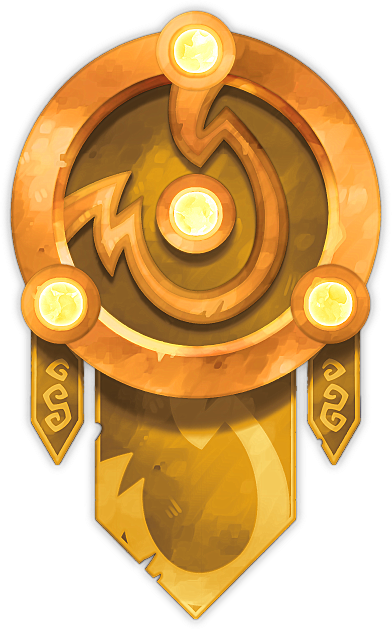
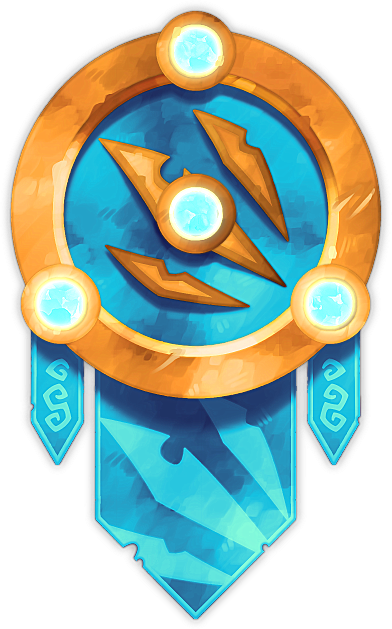
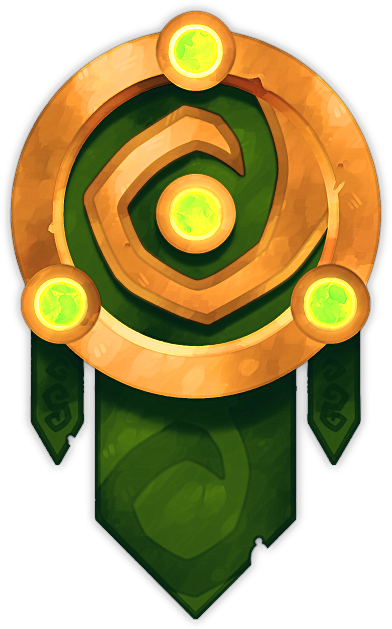
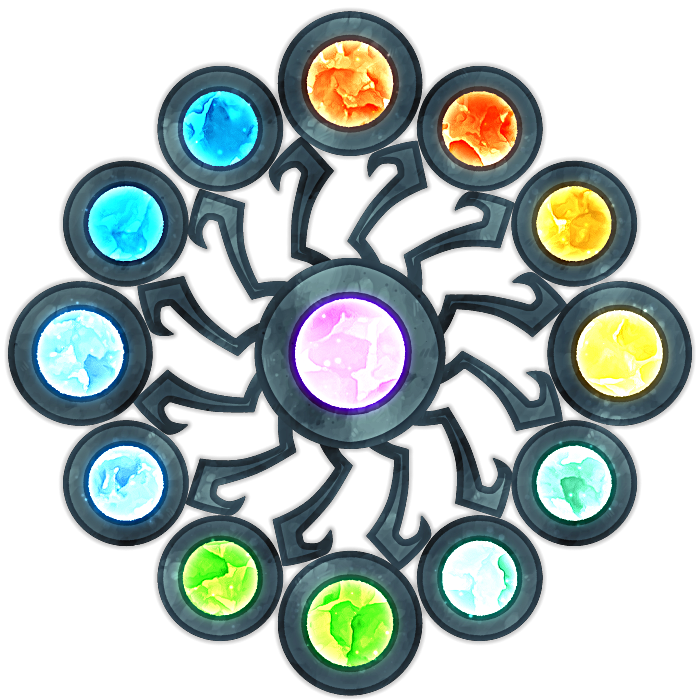
In the known beginning, there were four Elements; Fire, Ice, Electricity, and Earth. These are now known as the Primordial Elements. Fire was hues of orange, Ice a range of Blue, Electricity flickers of yellow, and Earth shades of green.
Variants
Over time, and as dragons of different Elements had children together, minor variations in their Elements emerged. These variations were not only different colors, but had slightly different attributes as well, and dragons gain these Variants under specific conditions, that being inheritance, elemental purity, or lack of elemental purity.
A dragon only ever has a single variant, the one they’re born with.
Some variants are born of Elementally pure lineages, others are born of specific Element-mix pairings. For example, Blue Fire is the ‘purest’ variant of Fire—a first generation Blue Fire dragon is born only to pure Fire families (only Fire dragon ancestors going back at least ten generations). A pure variant amplifies the ‘core’ aspect of its given Element, in this case heat; Blue Fire is hotter than the original Orange Fire variant. It does, however, extinguish quicker and use more Mana.
Red Fire, on the other hand, is born from crossing with Ice (or Water, which comes from Ice). This variant is the least hot, but it will burn the longest and use the least Mana.
As such, no variant is superior to another. Each has a different strength and a different weakness.
Primary and Secondary Forms
Each Element comes in two forms. Dragons use the primary form (for example, Fire breath, Ice mist breath) when they awaken their Element and while learning to master control. Later, they can learn from an experienced tutor to summon their Element in secondary form (for example, Fire bombs and Ice shards), which need to be wielded differently as they have different functions and different attributes, or Virtues, such as damage method, speed of movement and charge, reach/range, area of effect, Mana cost, etc.
The different Elements have different Virtues also, such as Electricity being a fast Element, and Earth being a slow Element.
element of fire
Element of Fire
Fire is the Element of burning emotion; Fire dragons commonly discover their Element in a bout of intense emotion—whether negative or positive.
Elements are Magic, they will dissipate over time, and Elemental Fire is no exception—however, though most often it takes the heat with it when it extinguishes, a dragon’s Fire can sometimes cause natural fires to start in its wake. In the origin place of Fire dragons, Agni Flats, nature is fireproof—this is not the case elsewhere in the Realm. Fire dragons have more pressure on learning to avoid accidental discharge when mastering control of their Element, due to the destructive potential of a small accident, however rare.
The primary form of Fire is a breath of flames; it damages through burn, either directly or through igniting the target. At higher masteries, the Fire breath can push targets like a harsh wind.
Fire’s secondary form is explosive; a trained Fire dragon can breathe concentrated Fire in bursts that explode on impact, and these explosions become more devastating the more powerful the dragon is.
With advanced training, a Fire dragon can summon their Fire around horns and claws, effectively superheating them for augmented physical attacks, or summon their Fire to boost their physical prowess; increasing physical strength.
Fire Dragons with mastery over their Element can learn to affect natural flames; a Class II dragon could snuff out a torch’s flame or keep a fireplace burning, while a Master of Fire could bring a raging forest fire to a halt.
Fire dragons have a higher tolerance of heat, and are more sensitive to cold. They can still be burned, not immune to either natural fire or the Fire of other dragons. Heat resistance grows with a Fire dragon’s power; it is said a Fire Elemental can submerge themselves in lava and arise unscathed.
Fire’s Variants trade heat for duration and Mana; hotter Variants do faster damage, but demand more Mana, and die out faster.
Fire Variants
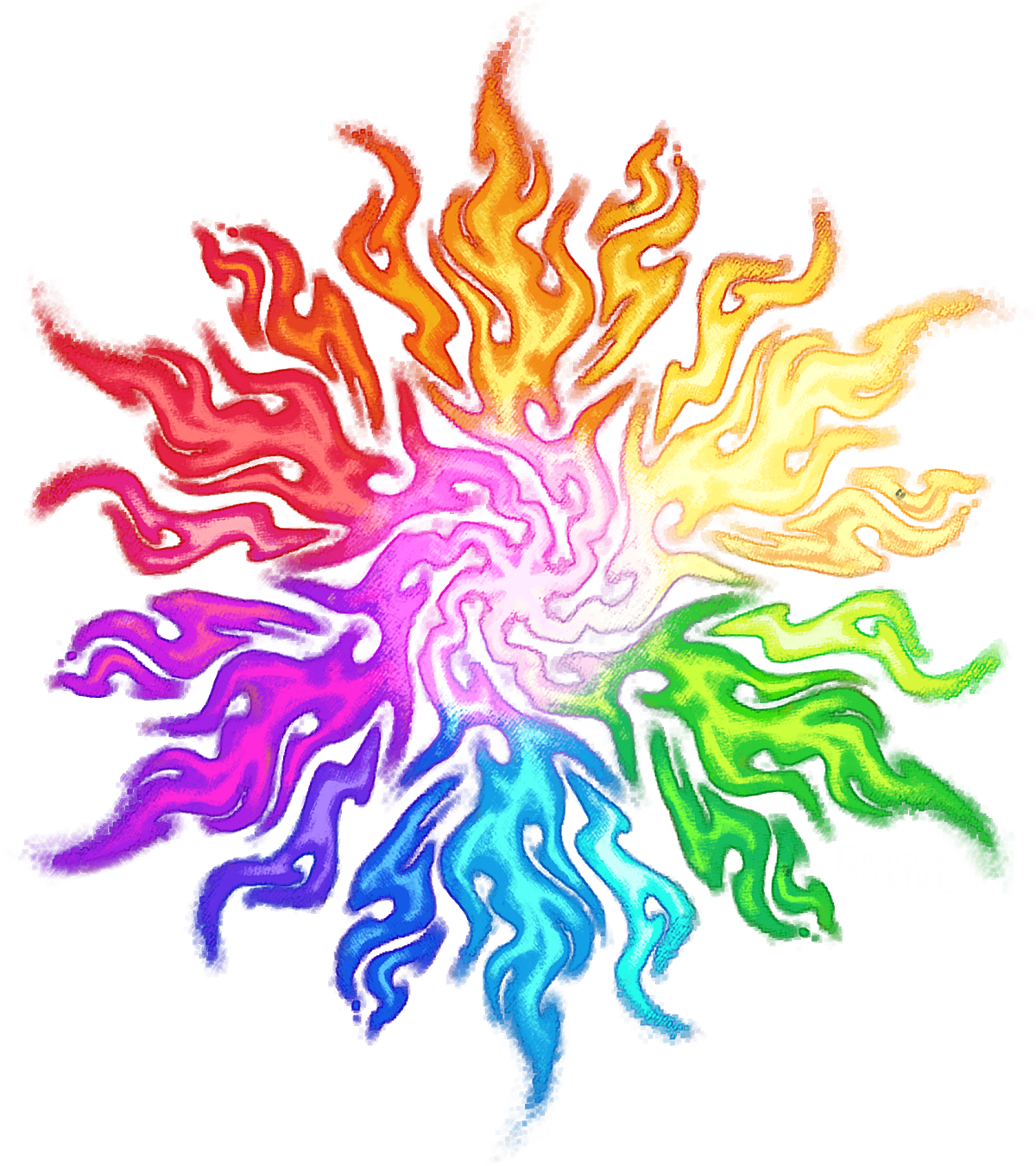
Original Fire (Orange)
40% of Fire dragons have this Variant
The original, or standard, Variant of Fire is Orange Fire, with hues in common with wildfire.
Yellow Fire
30% inheritance rate
20% of Fire dragons have this Variant
The second Variant of Fire. Yellow Fire ranges from golden flames to near-white. This Variant is born from crossing with Electricity; it is slightly hotter than Original Fire, moving erratically and sparking wildly. It can be a little harder to control.
Red Fire
30% inheritance rate
25% of Fire dragons have this Variant
Red Fire is the coldest flame, but burns the longest. Consists of hot pink, red, and hot orange flames. Occurs from Ice or Water impurity.
Pure Fire (Blue)
10% inheritance rate
14% of Fire dragons have this Variant
The second rarest Variant, and usually the hottest. This variant burns hot but extinguishes fast. Occurs initially only in pure Fire families, but can rarely be inherited in non-pure families (a non-pure Blue Fire dragon would always have a pure Blue Fire dragon ancestor).
Dark Fire (Green)
Unknown inheritance rate
<1% of Fire dragons have this Variant
Green Fire is born from dark blood, the mixing of Dark Elements. It is hotter than its redder counterparts, but colder than Blue Fire. This Fire spreads fast but burns slow.
Legendary Fire (Purple)
Cannot be inherited
No known dragons alive have this Variant
An oddity among the variants of all Elements. This variant cannot be inherited, and appears only on average once every four hundred years. Purple Fire is the hottest flame; purple Fire dragons are believed to descend from the first Fire Elemental, and are sent by said Ancestor to fulfill a great purpose.
As of 3016, no living wielder of the Legendary Fire is known.
Element of Electricity
Element of Electricity
Electricity is known for its speed; dragons of this Element are often characterized as being quick-witted, thrill-seeking, or impatient. The most common emotions to awake this Element are ones to strike suddenly; surprise, shock, a burst of adrenaline.
Scholars have drawn comparisons between Electricity and Fire, due to both having heat as a method of damage; though for the former, it is secondary. Theories of a magical relation between the two is a subject of occasional study and discussion, especially after the emergence of Descendant Elements.
Despite its heat characteristics, elemental Electricity does not cause things to catch on fire the way a strike of lightning easily does. While Fire burns from the outside, hotter Electric variants burn below the surface.
Electricity’s unique characteristic is shock; this is typically slow to damage, but can pass from target to target and paralyze an opponent, stopping them in their tracks.
Its primary form is a zagging line of Electricity, appearing in a flash between its summoner and their target and striking them hard. This line can branch out, dividing its damage potential between two or more targets (how many times Electricity can divide and pass between targets is mastery dependent).
The secondary form of Electricity is not a branch of lightning, but diffused, light-like Electric energy that is primed to explode outwards in shockwaves and Electric strikes; often taking the form of a semi-transparent, glowing ball or ‘arrow’, which can be wielded similarly to Fire bombs.
A trained Electricity dragon can summon their Element to enhance their physical speed, whether in combat, on foot, or on wing.
Electricity’s variants trade shock for heat or impact force.
Electricity Variants
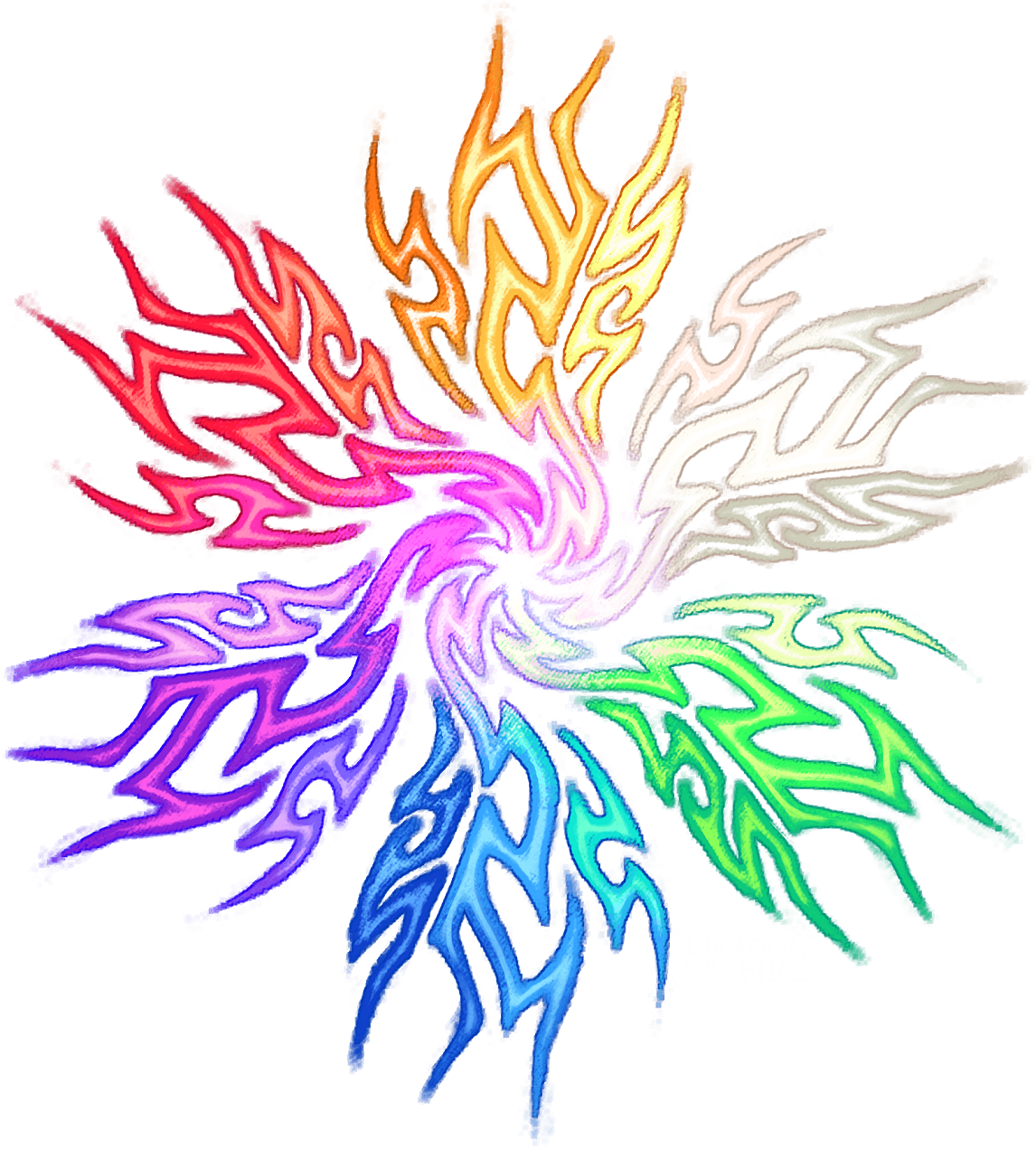
Original Electricity (Yellow)
33% of Electricity dragons have this Variant
The original form of Electricity; includes distinctly orange tints.
Purple Electricity
30% inheritance rate
17% of Electricity dragons have this Variant
Purple Electricity was the second Variant of Electricity to occur. It is a natural descendant of the Original Electricity, and is more likely to appear in pure lineages.
It is slightly colder than the Original Variant, and slightly more shocking.
White Electricity
30% inheritance rate
20% of Electricity dragons have this Variant
Originating from Fire mixing, White Electricity sears a little hotter than the Original form, and shocks a little less.
Pure Electricity (Red)
5% inheritance rate
3% of Electricity dragons have this Variant
The Pure form of Electricity. This is the least hot, but the most shocking of its sibling Variants. Burn damage from this Variant is nearly unnoticeable. Targets become paralyzed easier, with the trade-off that damage is less.
Blue Electricity
30% inheritance rate
17% of Electricity dragons have this Variant
Blue Electricity is the hottest Electric Variant, and the least shocking. The threshold for causing paralysis with this Variant is higher, but the increased burn offers more damage in turn.
Blue Electricity is a natural derivative of White Electricity. There is some debate on whether or not this makes it an impure Variant, however, it can be born from what is considered a Pure Electric dragon of White Electricity, without Fire blood. As such, it isn’t recognized as an impure Variant, but more commonly as a ‘purified’ Variant.
Fire impurity and hotter Electric Variants are thought to increase the chances of this Variant passing, while colder Variants and Ice impurity lessens its odds of passing.
Green Electricity
20% inheritance rate
10% of Electricity dragons have this Variant
Green Electricity is born of Earth or Wind impurities. Despite this, it can share the stigma of Green Fire; many mistaking this Variant of also being of Dark descent. Within cities and educated populations, this misunderstanding is not common.
This Variant is as hot as the Original Variant. It trades some shock ability for harder impact force.
Element of Ice
Element of Ice
Ice dragons are often perceived as cold, calculating, or proud, yet their Element often awakens in moments of grief and inner turmoil.
The primary form of the Ice Element is a breath of Ice mist. This imparts an instant chill that makes a target’s movement slow and painful, and causes frostbite. Ice mist, when continuously applied, will accumulate into solid Ice. This can encase a target’s limb or their entire body for some time, depending usually on mastery. The frost itself does not do as much damage as Fire’s burn, however, it makes a target much more sensitive to physical follow-up attacks, which they are also susceptible to due to being slowed.
Trained Ice dragons can exhale or summon ranged, concentrated balls of Ice mist that flash freeze an area or target on impact, leaving solid Ice in its wake. One can also learn to harness Ice to enhance one’s physical endurance, allowing them to fight through pain, reducing inflammation and bloodloss.
Ice’s secondary form is solid Ice, which can be exhaled as bursts of icicles or summoned as Ice-covered claws/horns/tail spades, or defensive iceberg walls. Solid Ice injures primarily through cutting—Ice is typically too fragile to stab deeply, and will shatter on direct impact, leaving shallow stab wounds.
Ice dragons have a resistance to cold and can survive harsh, blizzard-like conditions for longer than any other Element—but they are not immune, and will eventually perish like the rest. More powerful Ice dragons can survive more extreme cold, or for longer durations. Ice dragons are sensitive to heat in turn.
Ice’s Variants trade cold for sturdiness or sharpness.
Ice Variants
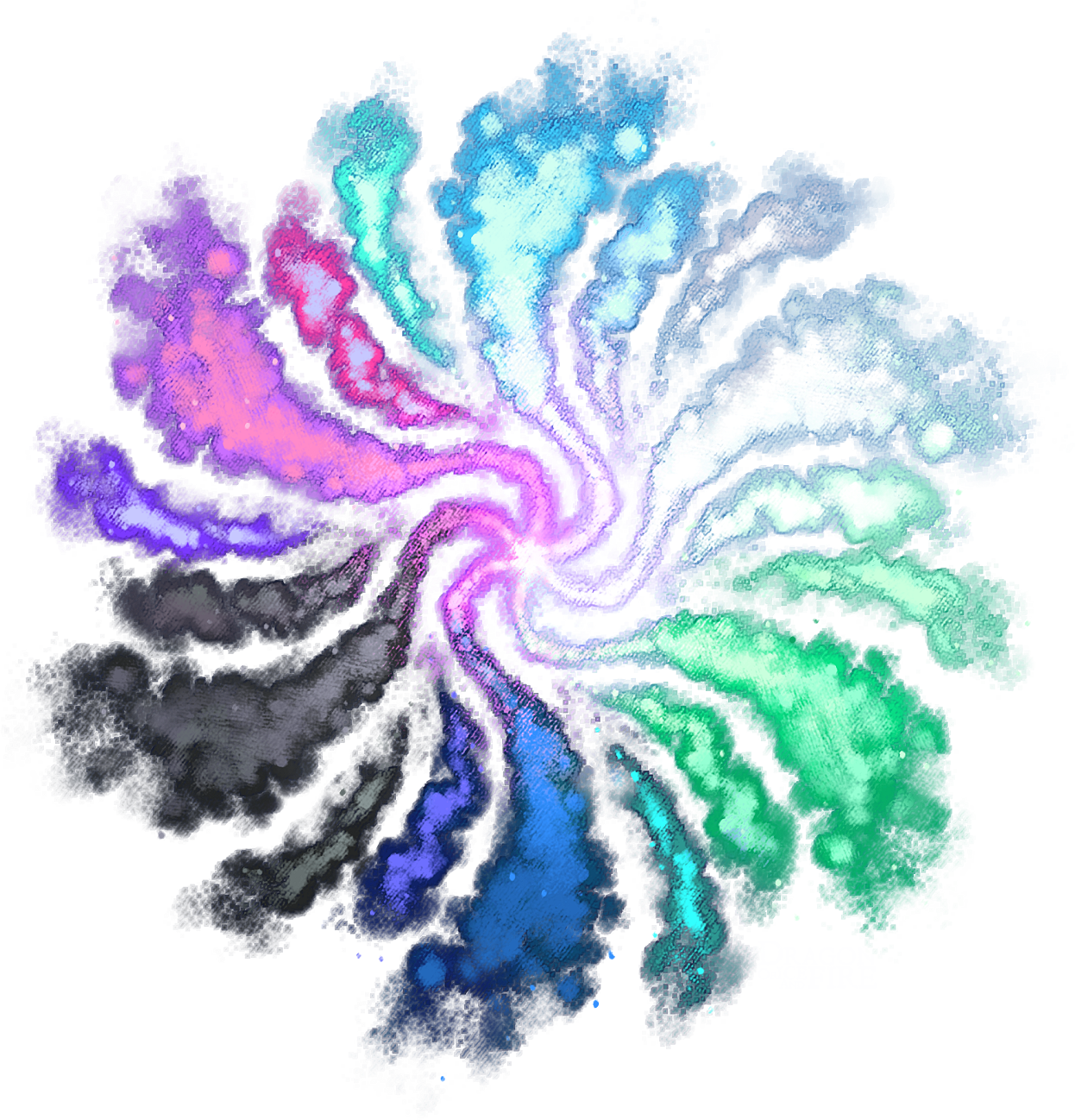
Original Ice (Blue)
40% of Ice dragons have this Variant
The Original Variant of Ice, composed of a range of middle to bright blues.
White Ice
35% inheritance rate
20% of Ice dragons have this Variant
The second Variant of Ice, a natural descendant of Original Ice. Slightly colder than its parent, and slightly more brittle.
Aqua Ice
30% inheritance rate
20% of Ice dragons have this Variant
From Earth or Wind impurity, Aqua Ice is less cold than Original Ice, but sturdier.
Pure Ice (Purple)
5% inheritance rate
3% of Ice dragons have this Variant
Pure Ice is the coldest of the Ice Variants, freezing targets with the most ease, but it is also the most brittle in its solid form. It can be solidified more easily, but shatters very quickly.
Deep Blue Ice
20% inheritance rate
8% of Ice dragons have this Variant
Deep Blue Ice is born from Fire and/or Water impurities. It’s the least cold of all Ice Variants, resulting in a slushy Ice breath that sticks to targets, chilling them for longer and more easily than other Variants. Though it is difficult for this variant to fully freeze targets, they can slow them down for longer.
Solid Deep Blue Ice does not feel fully solidified, and crumbles more than it shatters.
Dark Ice (Black)
Unknown inheritance rate
<1% of Ice dragons have this Variant
Born of Dark Element impurity, Black Ice is as cold as Aqua Ice, but the sharpest of all the Ice Variants.
Element of Earth
Element of Earth
The Earth Element encompasses nature, and its dragons can be seen as equally adaptive, unyielding, or stubborn. Earth dragons tend to discover their Element when expressing these qualities, such as when standing their ground in an argument, or a fight.
Earth’s primary form is energy, breathed in spaced-out, concussive blasts, or like an energy wrecking-ball that swings into its targets—either way, it’s slow-dealt but powerful impact damage that sends targets tumbling back.
Earth’s secondary form shapes its Earth energy into avatars of nature itself; largely depending on Variant, this can be leaves and vines, trees and roots, or stone—enabling the dragon to slash, pierce, ensnare, or crush their targets.
A trained Earth dragon can channel their Element to affect true nature; strengthen crops, shape terrain, move impossibly heavy stone and bind it together with other stone seamlessly—or summon it to enhance the defense of their bodies, making them harder to injure.
Earth’s Variants give a dragon an inclination to the different aspects of nature, but does not lock one out entirely. An Earth dragon divides their influence among their favored aspects or focuses entirely on the one they are born into.
Earth Variants
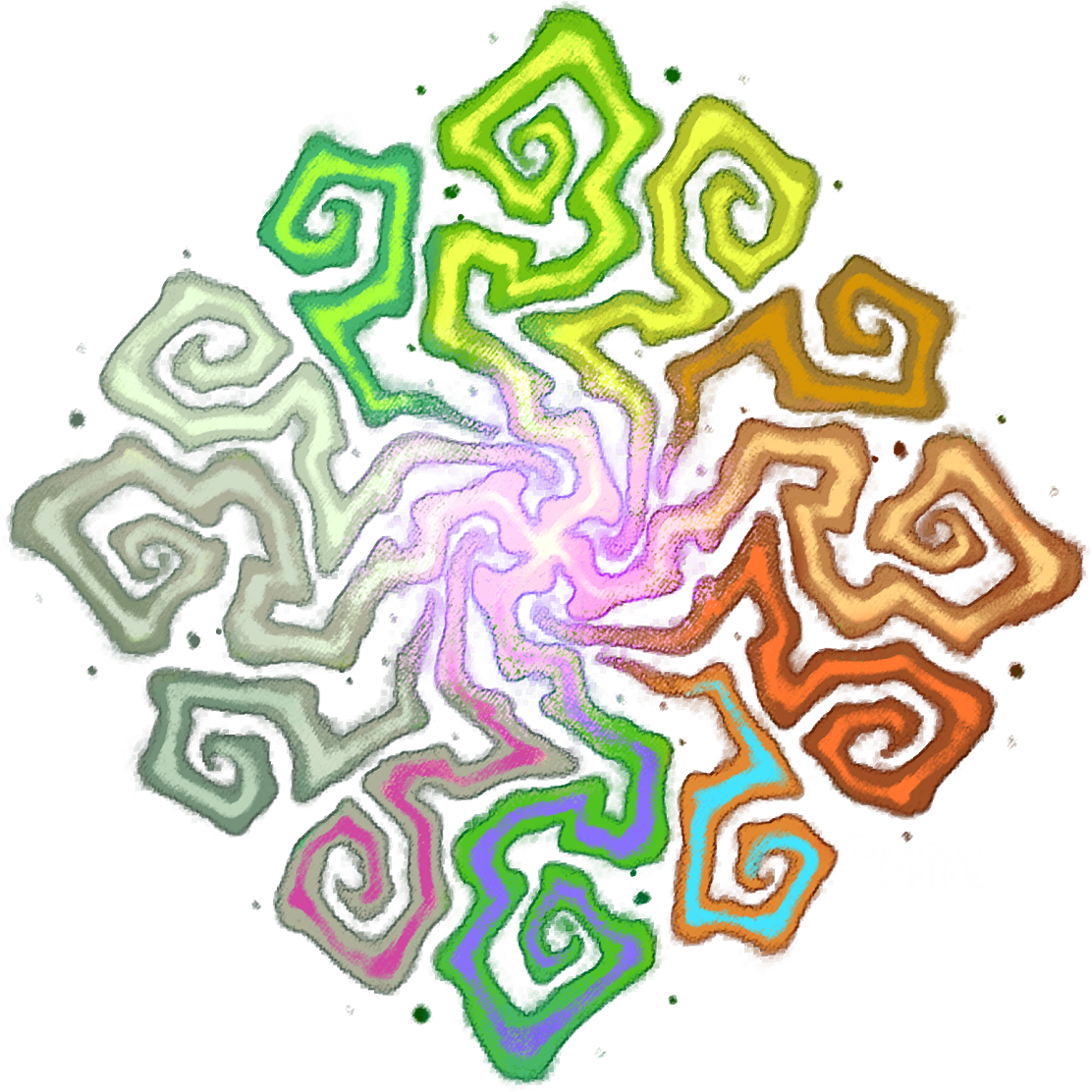
Original Earth (Green)
40% of Earth dragons have this Variant
The original Variant of Earth, with colors ranging from bright and warm greens, to dark and cold greens.
This Variant gives the dragon the most affinity towards green aspects of nature, such as leaves and vines.
Brown Earth
30% inheritance rate
25% of Earth dragons have this Variant
A natural descendant of Green Earth, this variant gives an inclination towards sturdier Earth, like wood and roots.
Grey Earth
30% inheritance rate
25% of Earth dragons have this Variant
A natural descendant of Brown Earth, Grey Earth offers the most control over lifeless nature, that of stone.
Pure Earth (Prismatic)
10% inheritance rate
10% of Earth dragons have this Variant
The Purest form of Earth offers a more even inclination to the aspects of Earth. Prismatic Earth Variant dragons can approach a ‘jack of all trades, master of none’ influence of all nature’s aspects, but typically gravitate towards one or two for better control. They can specialize most easily in the aspect represented by their primary Element color.
The Descendant Elements
The Descendant Elements

In the thousands of years since, two new Elements emerged from the crossing of Primordials; Wind, and Water. Wind’s roots, or ‘parent Elements’, are Electricity and Earth, and Water comes from Fire and Ice. Wind and Water are considered derivative, or ‘Descendant’ Elements.
When a pairing of a pure Fire dragon and a pure Ice dragon have children, each child has a 1% chance of being a first-generation Water dragon. This eventual Water dragon can then have children of their own that can be Water dragons at normal inheritance odds.
It is taken as fact that other Descendant Elements will eventually emerge from remaining Element combinations; such as Fire and Earth, or Ice and Electricity. What these Elements will be, one can only speculate.
It is a common belief that Descendant Elements themselves cannot birth new Descendant Elements. They are often considered inferior to Primordial Elements, in much the same way a child is inferior to their elder.
element of wind
Element of Wind
Wind is the Element that embodies grace and flight; Wind dragons often discover their Element when they learn to fly, or in moments of freedom or escape.
Wind’s primary form is a breath or summon of magical Wind that can sweep a target off their feet or wing, throw them off ledges or into walls—or pick up lighter objects like debris and launch them into a target.
Wind dragons often use this form to boost their attack or flight speeds and/or limit the need to beat their wings. A trained Wind dragon can focus their Element inwards to enhance their physical agility.
Wind’s secondary form is a burst of concentrated Wind, allowing the Element to damage by direct impact like a whip, bruising or cutting, depending on mastery.
The Variants of Wind determine if the Element favors speed over lift; with higher speed pushing targets more easily, but lesser lift not picking targets or objects up as easily or often. Essentially, the former is more inclined to damage by throwing a target into objects, while the former damages by throwing objects into targets.
Wind Variants
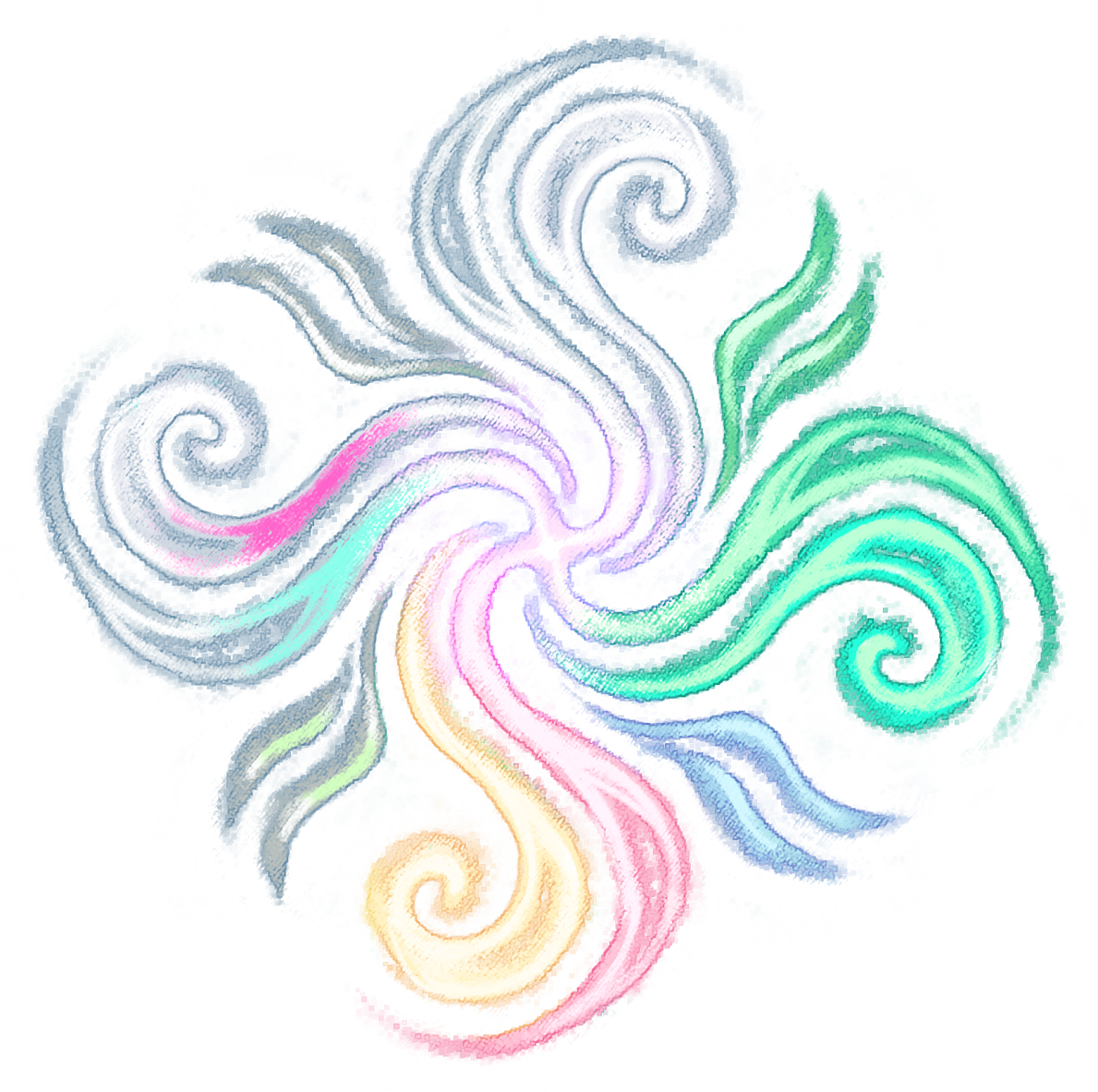
Original Wind (Grey)
35% of Wind dragons have this Variant
The original Variant of Wind, a range of bright to mid-range greys.
Teal Wind
40% inheritance rate
30% of Wind dragons have this Variant
A natural descendant of more Earth-heavy Wind lineages, Teal Wind offers more lift by trading speed.
Tinted Wind
30% inheritance rate
25% of Wind dragons have this Variant
The opposite of Teal Wind, Tinted Wind comes from more Electricity-biased Wind lineages, and offer more speed with less lift.
Tinted Wind can be any pastel color, but never multiple colors at once.
Pure Wind (Iridescent)
10% inheritance rate
10% of Wind dragons have this Variant
The Purest form of Wind blows the fastest, but has the least amount of lift.
Iridescent Wind reflects the colors of Original Wind, but with a saturated, extra color like a sheen.
element of water
Element of Water
The youngest natural Element; Water dragons can be known to be agreeable and non-confrontational, or the exact opposite. Land-living Water dragons may discover their Element at the height of a special event, whether positive or negative, or in a sneeze or the midst of a laugh.
Ocean-living Water dragons may discover their Element unknowingly, one day realizing they’ve been unconsciously using it to enhance their swimming.
Water’s primary form is a stream of Water, which can be breathed or summoned with significant pressure behind it. The water by itself does no damage, but it moves fast enough to push and bruise; often used to slam targets into walls or other targets, or sweep them away.
Uniquely, Water dragons who come from generations living in the ocean develop an inclination towards non-exhalation, similarly to certain Abnormals. Exhalation is not beneficial below the waves, so their Element is used for very quick and maneuverable swimming, and manipulating other underwater targets such as predators, prey, and opponents. Unlike Abnormals that cannot exhale their Element by default, this comes more and more intuitively to ocean-living Water dragons the more generations that pass. Exhalation becomes the difficult skill, and if it comes to combat above the sea, these Water dragons become fish out of water, wielding an Element with no utility.
Water’s secondary form becomes far more compressed and narrowed, its pressure further increased, shifting from a pushing, bruising force to a cutting one.
A trained Water dragon can turn their Element into a boost that enhances their physical stamina, allowing them to exert themselves for longer—useful for swimming if not combat.
Water’s variants trade pressure for spread.
Water Variants
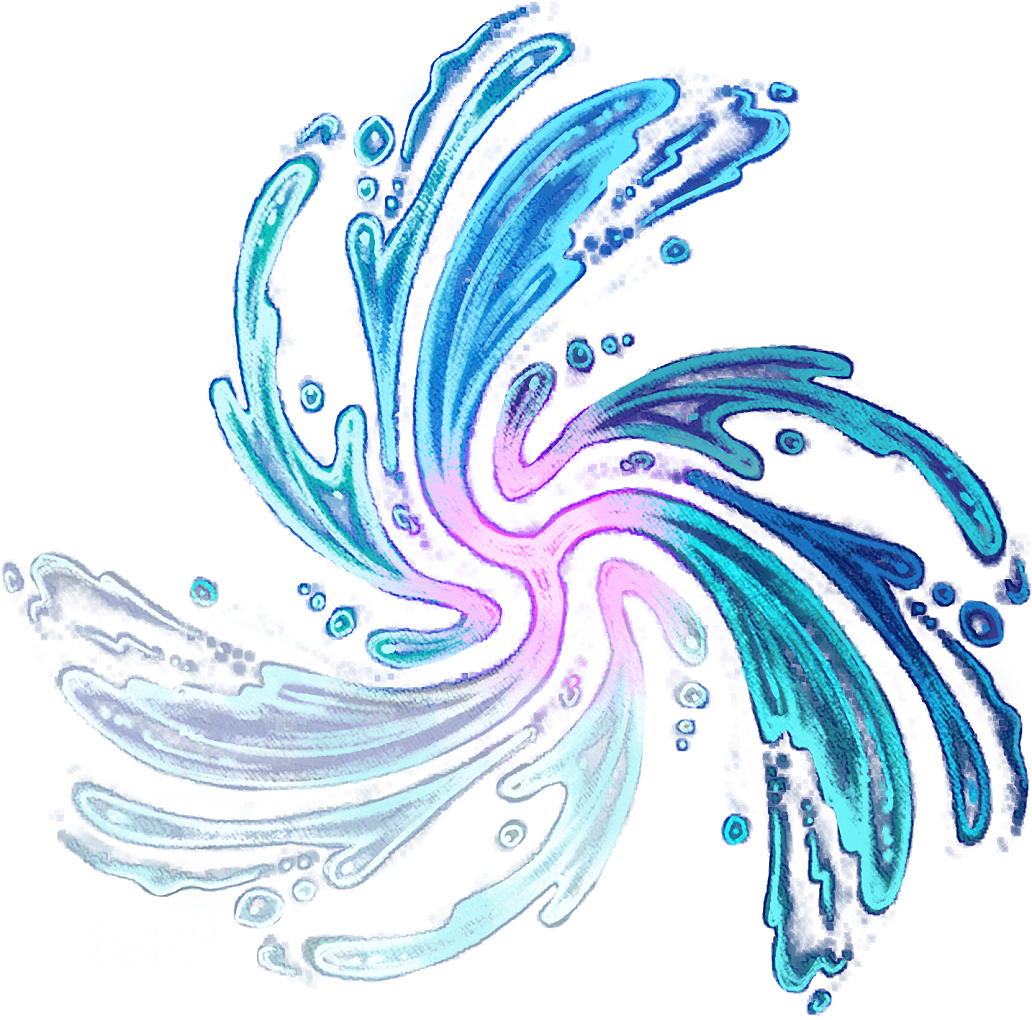
Original Water (Light Blue)
59% of Water dragons have this Variant
The original Variant of Water, showing a range of bright to mid-range, saturated blues.
Deep Blue Water
40% inheritance rate
39% of Water dragons have this Variant
A natural descendant of the Original Variant, Deep Blue Water is comprised of the darker shades of blue, yielding a Water breath with heavier pressure, but wider spread; less cutting, more bruising.
Pure Water (Clear)
5% inheritance rate
2% of Water dragons have this Variant
The Pure Variant of Water, nearly colorless and translucent, is the most precise, allowing for thin, fast cutting streams of water, with the tradeoff of having the least force and spread.
The Dark Elements
The Dark Elements
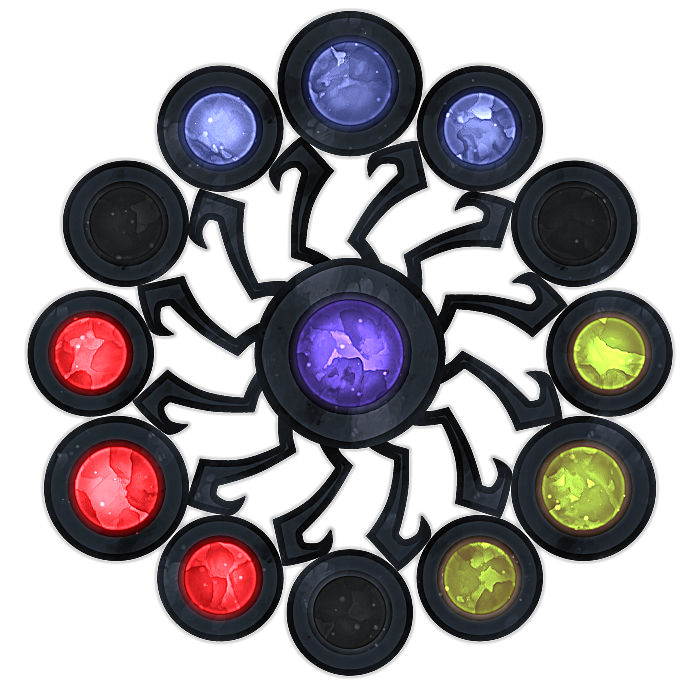
Then there are the Dark Elements; born not of natural descendance, but of something known as Corruption; a process wherein a dragon of Primordial or Descendant Element twists their spirit and body into a new, dark Element. Three of these corruptions birthed new Dark Elements; Shadow, Fear, and Poison. In these Corruptions, the dragon loses all connection to their birth Element in favor of their new one; their progeny will take only from their new Element, as though all signs of the past are washed away.
Element of Shadow
Element of Shadow
The first of the Dark Elements, Shadow takes some after its progenitor Element, Fire, yet deviates in notable ways.
Shadow’s primary form presents itself like a dense, dark smoke, cold and asphyxiating.
Uniquely, Shadow exhalation is a higher ability for Shadow dragons; their primary ability is dematerializing into their Element and becoming Shadow, allowing them to dodge, infiltrate, and flank, then retaliate with long claws or blade spurs, or stronger Shadow attacks.
Unlike Fire, Shadow’s secondary form allows it to harden much like Ice, though only in motion—quickly either dissipating or becoming a dark haze again. This can be paired with dematerializing or exhalation to impart many small cuts, or a large slash.
Shadow’s most infamous effect is wielded by powerful Shadow dragons; mind control, the ability to, allegedly, influence and command other dragons to do terrible things.
Shadow Variants
???
Unknown.
???
Unknown.
???
Unknown.
???
Unknown.
Element of Fear
Element of Fear
Unknown.
Victims of powerful Fear dragons will be found with bloodshot eyes, bleeding ears, and vein-like marks spreading from their eyes; called Fear Bleed.
Fear Variants
???
Unknown.
???
Unknown.
???
Unknown.
???
Unknown.
Element of Poison
Element of Poison
Unknown.
Poison Variants
???
Unknown.
???
Unknown.
???
Unknown.
???
Unknown.
The Dark Elements have too intermixed with the natural Elements, birthing Dark Variants such as Green Fire and Black Ice. These are the most well known, however, they are not the only ones…
Element Inheritance
Element Inheritance
A dragon’s Element passes on to their descendants. Two dragons of pure Ice lineage will always have only Ice children. If a pure Ice dragon and a pure Earth dragon have children, each child has a 50/50 chance of being either Ice or Earth.
After ten generations of an Element not appearing in a lineage, the odds of it resurfacing disappear entirely. If a bloodline can only produce one Element, it is considered ‘pure’.
As of the Fourth Millennium, the amount of elementally pure bloodlines who can trace their lineages back to pre-Unification times, and have verifiably (through legitimate historical documents) never crossed with another Element, are in single digits—and disappearing. Elemental purity is still valued, especially in high society, but this purity is defined by the ‘ten generation’ rule, as only then is there no chance of a surprise Element.
Mixed dragons have a pool of Elements they could be born with, but inheriting the Element of either parent is most likely. With each generation that passes without an Element appearing, the odds of that Element appearing halves.
For example, in an otherwise pure Fire lineage, a dragon’s maternal great grandparent had Electricity. That dragon’s children (with a pure Fire dragon) have a 88.9% chance of being born Fire dragons, but an 11.1% chance of being born Electric dragons.
If the child’s other parent has an Electric great grandparent as well, the odds become 80% Fire and 20% Electricity.
These percentages are only odds. A pair of parents having children with a 10% chance of being Ice and a 90% chance of being Earth does not mean that having 10 children will guarantee 1 Ice child, only that it is statistically likely.
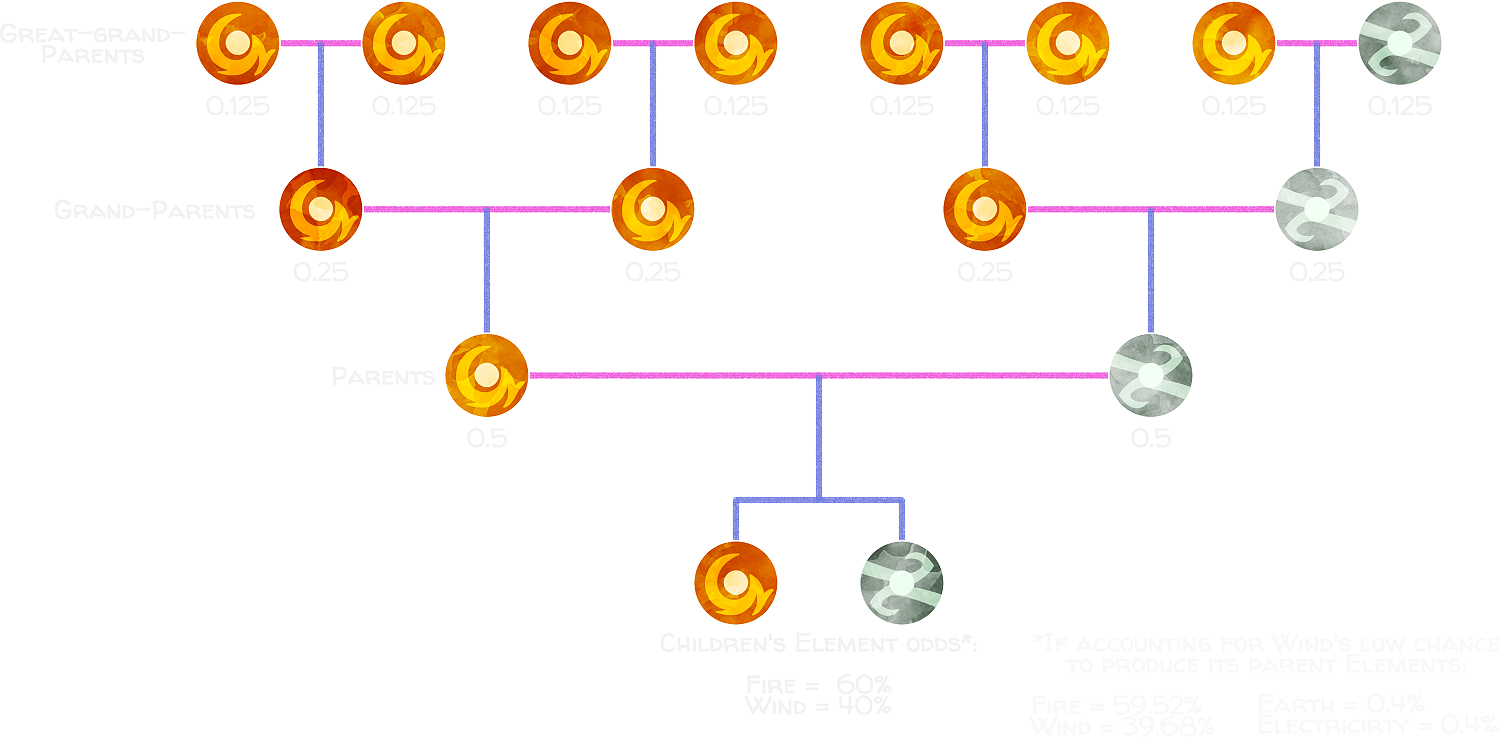
Every direct family member has a maximum influence (0 to 0.5) on a child’s Element.
Only the latest occurrence of the Element on one parent’s side of the family is considered.
- In the visual example above, a potential child descends from a pure Fire dragon and a Wind dragon with heavy Fire lineage.
- Fire Odds:
- 1st parent is pure Fire = 0.5
- Since this is the latest occurrence of Fire in this side of the family, any Fire Elements before this is irrelevant to the calculation.
- Grandparent on Wind parent’s side is pure Fire = 0.25
- Since this is the latest occurrence of Fire on the Wind parent’s side of the family, any Fire Elements before this is irrelevant to the calculation.
- 1st parent is pure Fire = 0.5
- Wind Odds:
- 1st parent is Wind = 0.5
- Since this is the latest occurrence of Wind on this side of the family, and there are no Winds on the other side, only this influence matters.
- 1st parent is Wind = 0.5
- Fire Odds:
- Total influence value = 0.75 + 0.5 = 1.25
- Child’s Fire chance = 0.75 / 1.25 = 0.6 (60%)
- Dividing by total influence value, then multiplying by 100, gives us a percentage chance.
- Wind will in 1 out of 100 times split into either Electric or Earth (its parent Elements), even if no ancestor within 10 generations has had these Elements.
- Take Wind’s total influence in a child’s potential Element, in this case 0.5, and divide by the total influence for a percentage. 0.5 / 1.25 = 0.4%
- The child has a 0.4% chance to be Earth, and a 0.4% chance to be Electricity.
- Water will do this as well with Fire and Ice.
- Wind will in 1 out of 100 times split into either Electric or Earth (its parent Elements), even if no ancestor within 10 generations has had these Elements.
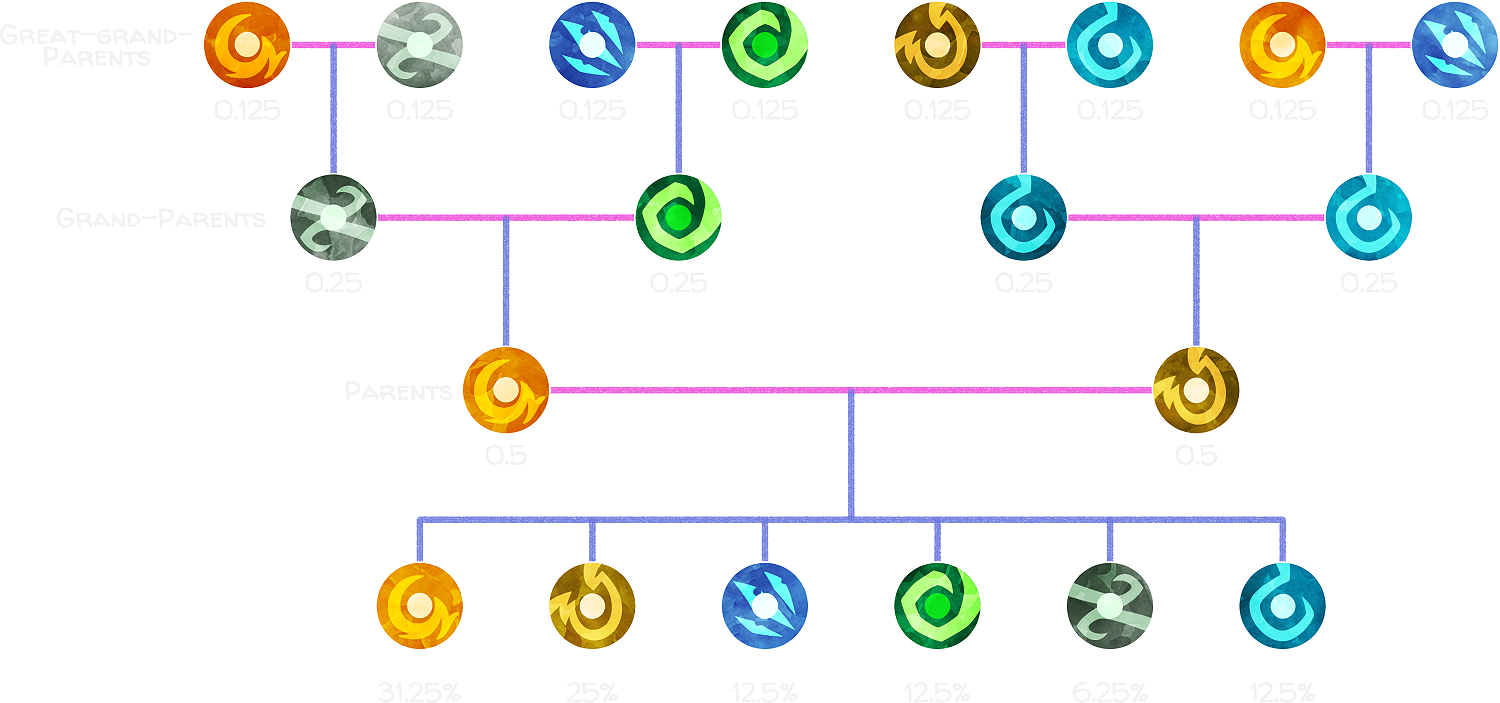
Detailed Explanation
- The example above is a very mixed lineage.
- Fire:
- 1st parent is Fire = 0.5
- Great-grandparent of 2nd parent is Fire = 0.125
- Total influence = 0.625
- Fire:
- Electricity:
- 2nd parent is Electricity = 0.5
- No Electricity on 1st parent’s side.
- Total influence = 0.5
- Electricity:
- Ice:
- 1st parent side; great-grandparent = 0.125
- 2nd parent side; great-grandparent = 0.125
- Total influence = 0.25
- Ice:
- Earth:
- 1st parent side; grandparent = 0.25
- No Earth on 2nd parent’s side.
- Total influence = 0.25
- Earth:
- Wind:
- 1st parent side; grandparent = 0.25
- No Earth on 2nd parent’s side.
- Total influence = 0.25
- Wind:
- Water:
- No Water on 1st parent’s side.
- 2nd parent side; grandparents = 0.25
- Total influence = 0.25
- Water:
- Total influence value = 0.625 + 0.5 + 0.25 + 0.25 + 0.25 + 0.25 = 2.125
- Child’s Chances:
- Fire = 0.625 / 2.125 = 0.294 = 29.4%
- Electricity = 0.5 / 2.125 = 0.235 = 23.5%
- Ice = 0.25 / 2.125 = 0.118 = 11.7%
- Earth = 0.25 / 2.125 = 0.118 = 11.7%
- Wind = 0.25 / 2.125 = 0.118 = 11.7%
- Water = 0.25 / 2.125 = 0.118 = 11.7%
Variants have a different kind of inheritance. Different variants have different chances of passing to a child. If all non-original Variants in the child’s lineage fail to pass on to them (by random roll), the child’s Variant becomes the Element’s Original Variant, even if the child’s direct Ancestors have not had this Variant in generations. Pure Variants have especially low chances of passing on.
Like Elements themselves, Variants will disappear from bloodlines if not resurfaced. Variants with a lower base chance of passing on will disappear faster.
Original Variants, however, will always persist, their passing chance being whatever remains when the odds of other Variants in the blood are tallied.
Additional Information
For example, the chance of Grey Earth to pass from a parent to a child is 30%. If the other parent is Green Earth (Original Variant), each child has a 30% chance of having the Grey Earth variant, and a 70% chance to have Green Earth.
If both parents are Grey Earth however, the odds double, and each child has a 60% chance of being born with Grey Earth. If the Variant still fails to pass (the child does not roll the 60% chance), they are born with Green Earth instead, because ‘missed’ Variants will default back to the original Variant.
Original variants do not have their own odds of passing on; other Variants’ odds are simply diminished, halved with each generation since its last occurrence.
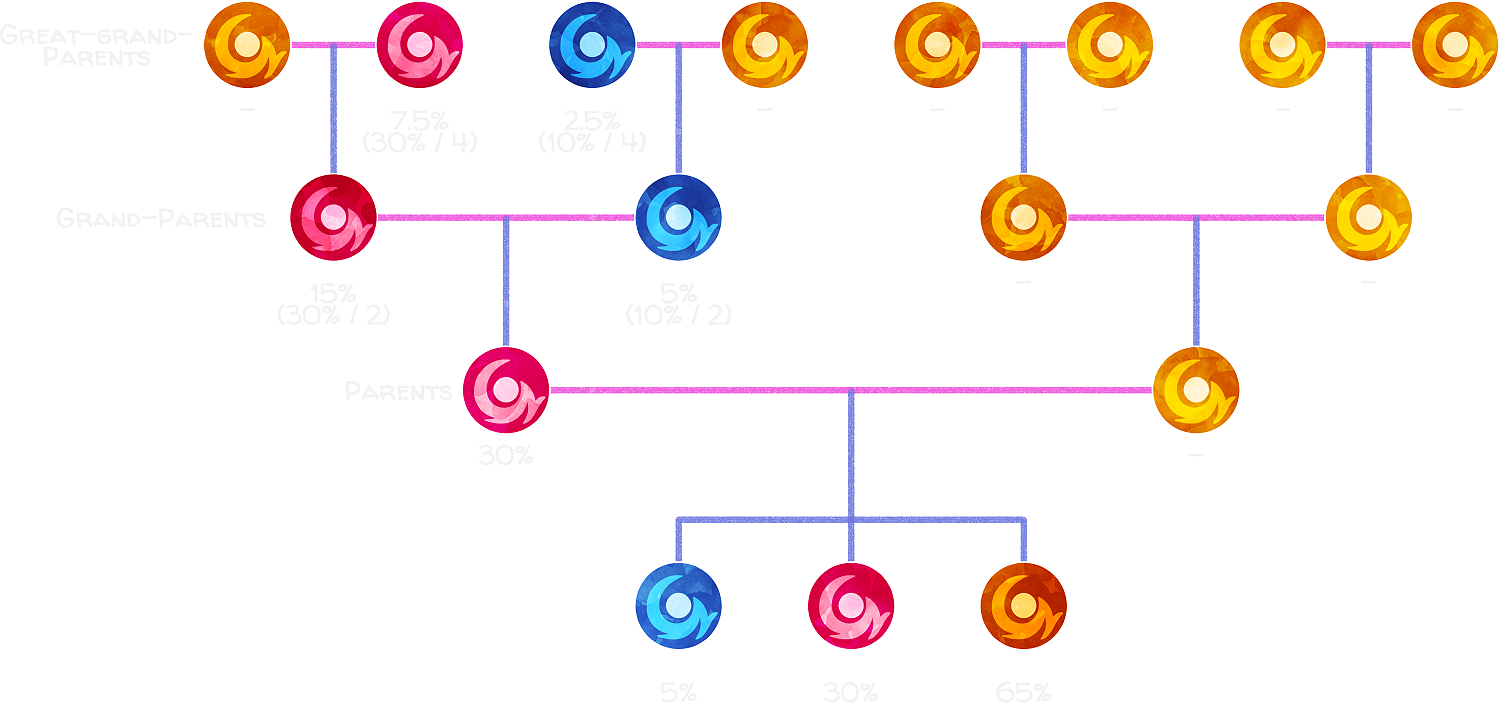
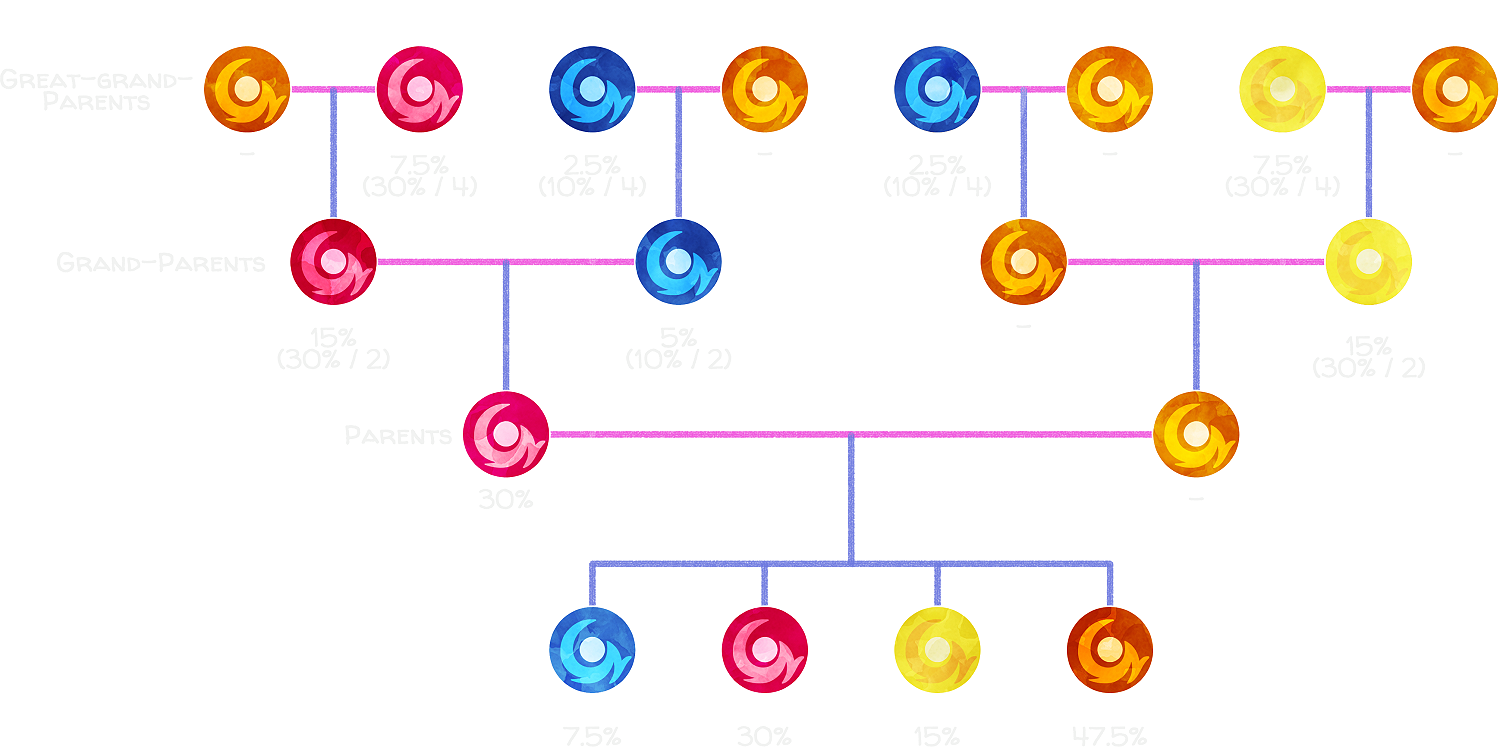
Here is a pure Fire lineage with Red and Blue Fire in the mix.
Red Fire passes from a parent to child at 30% chance. Blue Fire passes at a 10% chance. These chances are halved with each generation.
- Since the 2nd parent’s lineage is only Original Fire (Orange), these don’t need to be tallied.
- The latest Red Fire in the lineage is the 1st parent, which gives the base 30% chance.
- The latest Blue Fire in the lineage is the grandparent, giving the base chance 10% divided by 2; 5%
- The Orange Fire passing chance is what remains; 100% – 30% – 5% = 65%
Detailed Explanation
Here is a another pure Fire lineage with Red, Blue, and Yellow Fire in the mix.
Yellow Fire passes from a parent to child at 30% chance.
- The latest Red Fire in the lineage is the 1st parent, which gives the base 30% chance.
- The latest Yellow Fire in the lineage is the grandparent on the 2nd parent side, giving the base chance 30% divided by 2; 15%
- The latest Blue Fire in the lineage is the grandparent on the 1st parent side, giving the base chance 10% divided by 2; 5%. There is also a Blue Fire in the 2nd parent’s side, a great-grandparent, giving the base chance 10% divided by 4; 2.5%, combined for a total of 7.5%
- Like with Elements, if an Element or Variant is in both parents’ bloodlines, the odds are combined.
- The Orange Fire passing chance is what remains; 100% – 30% – 15% – 7.5%= 47.5%
The only known exceptions to these rules are found in the white dragons of Scions Aether. Each fully white child has a 1/6 chance for each Element, regardless of their parent or recent ancestors. This is due to their methodically mixed lineage reaching back thousands of years. This even randomness applies to their Variant also, ironically giving them the highest odds to be born with pure Variants.
awakening
Awakening
A dragon awakens their Element somewhere between ages 0 to 20, with a mean around 7 to 13. Extreme early awakening (0 to 3 years old) is incredibly rare. It’s very rare to go into and beyond age 30 without consciously summoning one’s Element once.
Like with flying, children are taught by their families (usually) how to breathe their Element. It never happens on the first attempts; children may run from family member to family member to neighbor to ask for advice and demonstration, and will play with other children pretending that they have their Elements.
Children who receive no guidance can very well go into adulthood without being able to breathe their Element. It’s uncommon to learn entirely on one’s own.
When a child or dragon finally does successfully summon their Element for the first time, it may be an entirely random event, during teachings from a family member or tutor, or it could be in a fit of emotions. Each of the three options is about equally common. Some may awaken their Element to defend themselves from danger, but this is not reliable enough to make endangering, or scaring, one’s child into awakening their Element worthwhile.
When it comes to emotional awakening, different Elements often tend to ‘favor’ certain feelings.
Favored Emotional Awakenings
Emotional Awakening
- Fire
- Outward feelings; anger (but not frustration, which hinders the needed clarity), or burning love.
- Ice
- Inward feelings; sadness and grief, or pride in oneself.
- Electricity
- A burst of adrenaline and energy; excitement, panic, surprise, shock.
- Earth
- Digging claws into the dirt; a moment of stubbornness, bravery, or defense of oneself or others, whether verbally or physically.
- Wind
- Movement and flight; feelings of freedom, or escape.
- Water
- A sudden change or a slow climb; the conclusion of a joyous or tense time.
These inclinations of the Elements in regards to discovery are thought to align with the nature of the Element itself, and the natures of the dragons who wield them. These are not rules however, and there are many exceptions.
Early Awakening
Elemental Awakening is not truly a case of ‘the sooner the better’. Very rarely, a hatchling may discover their Element within the egg, summon it unconsciously, and destroy their egg, leading to their death. Guardians may sense an in-egg Awakening about to happen.
While age of awakening varies, basic control of one’s Element is succeeded generally in middle teen years, so children with early awakenings spend longer with Elements that are not in their own control. This is dangerous, as before this basic control, their own Element can bring them or others (other children, especially younger ones) harm.
Many dragons see this as a badge (and the cost) of ‘strong lineages’, as early awakenings typically occur in elementally powerful bloodlines (though not exclusively, and most children in these bloodlines still awaken their Elements in the average range). Children who awake their Elements early are believed to be gifted or destined to become powerful themselves; though without meeting the real requirements of ascending mastery, early awakening has no effect on achieving power, nor does it usually provide a head start.
Late Awakening
Typically, Elements are awakened by age 20 at latest—crossing into adulthood without Element is cause for concern, especially if the dragon frequently attempts to awaken it and has been thoroughly instructed. In such cases, it usually is a case of a very stunted Element. Often this delay coincides with a permanently weak, Abnormal Element.
This could also happen in children due to stressful home lives, trauma, or abuse, which often delays Awakening.
Other times, late Awakening is a result of inbreeding. Heavily inbred dragons become progressively (by generation) weaker in Element, until a point where their Element is too weak to awaken, and in turn too weak to keep the dragon alive. Their bodies wither and they pass away, usually between ages 10 and 20.
Oftentimes, and in all cases for those over 40, dragons whose Element has ‘not awakened’ actually do have an awakened Element, a so called ‘hidden awakening’ or ‘sleep awakening’. The older they are, the more likely they are to still struggle to actually reach their Element, but once they truly pass that threshold, the Element fully comes alive and they must learn Control. Only the very elementally sensitive (like Masters Scholars and Guardians of the given Element) can tell whether or not a dragon’s Element is yet awakened.
Hidden awakenings often coincide with Abnormal Elements that are very weak or uncontrollable, and can either way result in an Element that is barely, if ever, consciously summoned despite being Awakened.
The only dragon who survives their whole life without any Element whatsoever is the Seer, though they are technically born with one. A Seer begins their life as a normal egg with a normal Element until the Seer magic passes to them (when the previous Seer dies), and what was to be their elemental awakening is the awakening of their unique powers instead, which then overpowers even their appearance, replacing Elemental aspects. The Seer’s magic sustains their lifeforce instead of an Element.
control
Control
After Awakening, a dragon must learn to control their Element. Until then, they will summon their Element accidentally, be unable to summon it every time they want, and unable to summon their Element at its full power. They will also not have immunity to their own Element and may hurt themselves with it.
Teaching control to a child is somewhat involved, and a bad or cruel teacher may worsen a child’s ability to master control of their Element. Usually, the older the child is at Elemental Awakening, the easier time they have learning control.
Immunity
There are different levels of control. Immunity is the ability to not be hurt by one’s own Element. Some gifted children have this nailed down immediately, others may struggle, achieving this skill last.
Once fully achieved, immunity becomes subconscious in dragons; they won’t have to think about it.
Intent
Intent is the ability to not accidentally summon one’s Element. This is different from emotionally summoning one’s Element*. A dragon who hasn’t learned intent control may spark their Element randomly while just speaking. These accidents are typically minor and cause no damage/injury, but there is a reason why dragons prefer stone buildings. This level is typically the second one reached; frequency of accidental summoning will decrease until it stops. This level is especially hard for younger children, as it requires more focus and impulse control.
*this will still have a level of control, a dragon may huff their Element in anger without thinking about it, but they would not unintentionally blast someone or something with it. This is considered a kind of body language, like a lashing tail or a raised voice, and equally informal.
Reliability
Reliable control is the ability to always summon one’s Element when desired. This is typically the last achieved level of control, requiring more clarity of mind. Under normal conditions, this is beyond a child’s capabilities or need. Children living in harsher conditions, such as on the streets/the wilds where reliable control is a matter of survival, will master it sooner. Abuse does not reliably accelerate elemental control unless a child is predisposed to abnormal mental fortitude/aggression (families such as Stormbringer selectively breed for such qualities, allowing their members to attain their achievable masteries sooner through early and difficult training). Trauma—especially childhood trauma— is for the vast majority of children debilitating in terms of Elemental control and mastery ascension.
Achieving Control
The Temples define a dragon as having a controlled Element when the dragon has gone at least six Moons without harming themselves with their Element, when it has been at least six Moons since an accidental discharge or since last failed attempt to summon one’s Element, and the Element meets expectations (like range, size, etc.). Mishaps may still occur, but should be rare.
Unintentional, unreliable Elemental summoning, or hurting oneself with one’s Element may still occur after mastering control, due to illness, intoxication, or extreme emotions. This is considered temporary regression of Element control, and only lasts until the cause subsides. Sometimes the cause may be something like immense grief or depression, and typically here dragons may only experience failure to summon their Element for some time.
Once a dragon has mastered control of their Element, they are typically an adult, and usually this level of Mastery is as complex and powerful as their Element will ever get. In current dragon society, the need for strong Elements in every dragon is severely diminished; most dragons spend their days doing work that does not require strong Elements, or require Elements at all. Without this necessity, or the drive, time, and resources to grow strong to achieve a goal, one’s Element remains average.
Element Mastery
Element Mastery
For many dragons, combat is central to their trade or their very lives, and so their Elements must also be. Dragons whose lives depend on strong Elements build strength with each deadly encounter and training session with more experienced mentors; increasing their Element’s power, reach, and flexibility.
Dragons formally classify abilities and overall mastery in a range of classes. Dormant (informally Class Zero) is a yet to awaken Element; Class I (one) means an awakened Element, and Class II (two) means a controlled Element. Here, the Element is at average power, and most dragons don’t go beyond this point.
Classes III (three) to X (ten) is an exponential increase in the baselines. Put simply, higher mastery enables the dragon to summon more of their Element at once and over time, and yields a higher level of fine control that enables the dragon to do more with the Element, such as turning Fire breath into a Fire bomb, superheating claws or horns, or engulfing oneself in flames.
Mastery Classes are only a classification; ascension is gradual, not a sudden increase in power.
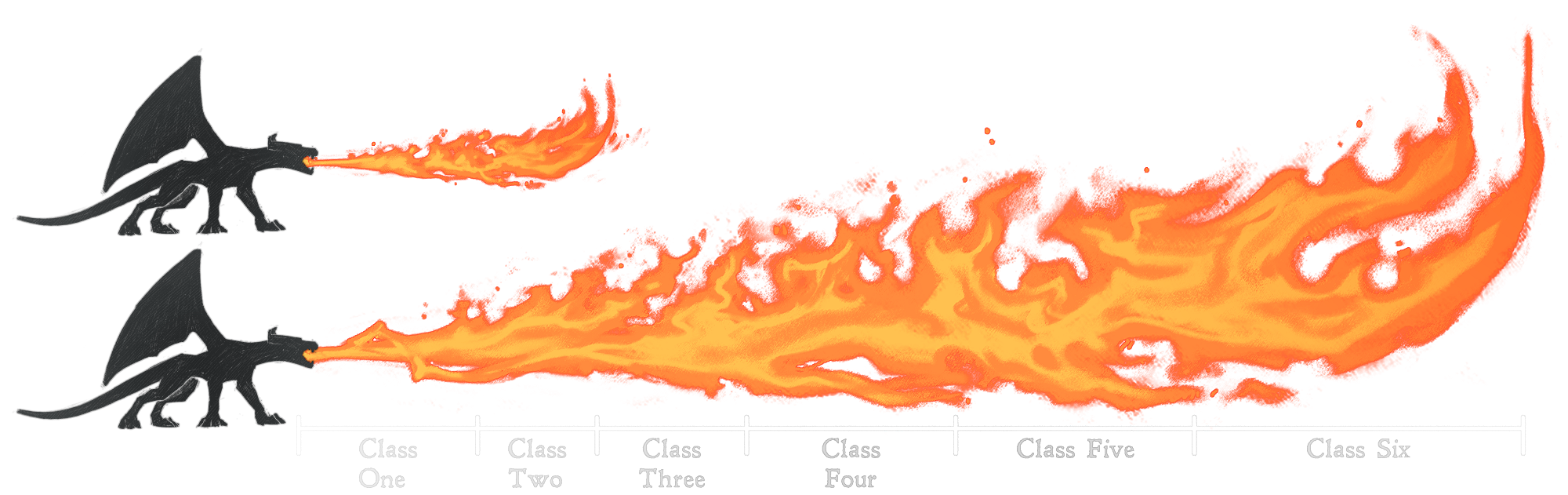
Mastery Classes
Dormant
~15% of dragons have not yet awakened their Element
Mainly dragons aged 0 to 20
Class One [I]
Awakened
~15% of dragons have an awakened Element not fully under control
Mainly younger dragons who in recent years Awakened their Element
Class Two [II]
Controlled
~40% of dragons have a controlled Element
Most dragons
Class Three [III]
~25% of dragons have this mastery
Typically career military and other dragons with frequent Element usage like guards and big-game hunters
Class Four [IV]
~13% of dragons have this mastery
Typically middle-rank military officers and late elder dragons after life-long frequent usage
Class Five [V]
~5% of dragons have this mastery
High-rank military officers and long-lived frontline soldiers, young Templars
Class Six [VI]
~1% of dragons have this mastery
Elite soldiers, senior Templars, Guardian Apprentices, leaders of power-hierarchies like Warlord armies and criminal syndicates
Class Seven [VII]
~0.1% of dragons have this mastery (~1000 individuals)
Elite soldiers, young Guardians
Class Eight [VIII]
~0.02% of dragons have this mastery (~200 individuals)
Senior Guardians
Master
Class Nine [IX]
~0.003% of dragons have this mastery (~30 individuals)
Elder Guardians
Elemental
Class Ten [X]
On average less than 5 living individuals
A dragon’s official placement on the mastery scale is assigned by a Master Scholar of the given Element; an expert who judges every aspect of the dragon’s abilities and combines them into a whole.
Dragons who are not Master Scholars, and even dragons with high mastery themselves, do not have such a fine tuned assessment of their own or others’ mastery. The common dragon perceives power in broad groups; average (Class One to Three), significantly powerful (Class Four to Six), and formidably powerful (Class Seven and above)*.
*Dragons may use similar verbiage, not exactly these terms.
Threading the Needle of Mastery Ascension
Elements are highly versatile, and the ability to wield it to its fullest potential is a lifelong commitment. The art of Elemental Mastery has long been studied by the Temples and its members, most notably the Guardians, and these sacred secrets are passed down selectively from mentor to apprentice.
A dragon cannot self-teach what has taken dragonkind millennia to uncover together; dragons are typically mentored, in some capacity, in Element from first exhale. Beyond Class II, most abilities must be observed, taught, and refined under the guidance of a mentor. In most cases, self-taught dragons, or dragons taught by a subpar teacher, stagnate in the lower masteries and know only a handful of crudely executed techniques.
The ideal elemental mentor is one who has studied under another master for a lifetime, not only learning to expertly wield their own Element, but to assess and see the subtle weaknesses in others’; learning to effectively guide other dragons in ways tailored specifically to them.
A good teacher is vital for growth, and the speed of said growth, and these teachers are few.
In this way, Elemental ascension could be compared to a dragon learning to become a master blacksmith or artist.
Mentors
Every high-mastery dragon has spent decades under the guidance of one or more mentors. These are usually tenured at the Temples, the military, and some practice privately. For-hire Element tutors are rarely above Class Five. The more powerful and wisened teach for ideals, not uncommonly for the sake of imparting the art itself, for legacy; choosing their few apprentices with high scrutiny. Sometimes this means teaching for free, which is typically the only opportunity for a dragon who does not have or come from wealth to receive training—but this is an exceptionally rare opportunity, as so many compete to simply be seen by a master seeking an apprentice.
The rest of the Realm moves heavily through coin. The non-wealthy have to make do with informal or second to third-hand tutoring, if any, and within the scarce minutes of time they have in between daily toiling work and other obligations. As such, higher mastery, power, has become a symbol of wealth; having the means to not only pay for decades of tutoring, but also free time to dedicate to it.
Lifestyle
Real combat is a non-negotiable pathway to mastery ascension; training alone is less than half of the equation, and training, too, often gets deadly. In present Warfang, combat is found largely through the Army, fighting Warfang’s wars.
This does mean that a large part of the scarcity of higher mastery is due to this deadly lifestyle. Most dragons die before reaching their potential. Therein comes a requirement of fortune, the fortune to not encounter a far superior opponent in the long path.
Perseverance
The process is long for most, and it is repetitive, frustrating, and painful. To ascend, dragons need the fortitude to pull through—emotionally and physically— each time they feel they cannot get back up again, to withstand and master their own mind and not be hindered by fear, self-doubt, and gruesome experiences. This cost grows heavier the higher the climb is. For the vast majority, there is a ceiling where the goal behind their drive is achieved, or more commonly, a part of them is insufficient to carry them beyond their current level—typically their driving force.
A driving motivation is mandatory, and higher mastery demands stronger drives; power is not found through just wanting power badly enough—there is a goal that fuels the dragon through suffering and countless near death experiences.
Beyond the noble ideals of the Temples, powerful dragons are overwhelmingly suspect; though admired and respected, those of immense power are characterized as having unnatural and/or dangerous psyches—single track minds unhindered by emotions of fear, doubts, and often empathy.
Abnormal Mastery
The mastery scale presents the typical development of Elements. For most dragons, exhaling their Element comes naturally, and they may be able to do more once they have attained a finer control of it.
Some Elements, however, defy this typical progression for reasons beyond the dragon’s control. Abnormal Elements never yield a net positive outcome; at best, and rarely so, they are neutral.
Around 1% of dragons are ‘Abnormal‘.
The Abnormal Types
The different types of Abnormal Elements can be classified as such;
Incontrollable
Try as they might, Incontrollable abnormals will likely never master control of their Element. If a dragon is never able to fully achieve the three levels of control, they will be classified as this type of Abnormal (this category is most often only applied to adult dragons over 25, as only then can it be confidently applied).
There are different levels of severity. Some of these Abnormals still achieve some level of control, whether by partially achieving all three levels of a controlled Element, or only one (for example immunity), or they have no control whatsoever and their Element becomes a significant burden in their day-to-day.
It is said that in very rare cases, Abnormals of this kind may break free of their curse (as many consider it so) in a life-or-death situation.
This legend has led to many tragedies.
Feeble
This type of Abnormal has some overlap with the Incontrollable abnormal. They will have struggles achieving total control of their Element (but rather than being largely incontrollable, they typically only have accidents of variable frequency), but are characterized by an exceptionally weak Element.
A 2-year old child awakening their Element does not wield it with the same power, range, or effect as a 12-year old child discovering their Element late. The younger the dragon is, usually the Element scales with them—this, believed to be either a form of natural protection, or simply these smaller bodies cannot contain a full Element. Nevertheless, Feeble abnormals find themselves near the bottom of this scale regardless of age.
They may control their Element, but it has little utility, and will not advance further. Compared to normal Elements of the same level of control, Feeble Elements fall short by 50% to 90% (for example, being both 10% the power and range of a normal Element—all other qualities included.)
As with the Incontrollable category, there have been cases where Abnormals like these are said to have overcome their condition through hardship and risk.
It is worth noting the dragons in these cases may have been mistakenly classified as Abnormals. There is little scholarly agreement if Abnormals of these types can overcome their condition or not.
Convoking
Where most other dragons exhale their Elements first, Convoking Abnormals awaken their Element without exhaling it. They may summon their Element around their paws, tail, or wings. Any low-level calling is possible. The dragon will not be able to exhale their Element at this stage.
As most calling (summoning Element without exhaling it) requires higher mastery power, these Abnormals are not able to summon their Elements completely and sufficiently; their calling is partial, difficult, and unreliable even once Class II is achieved; which is a feat, as Convoking Elements take longer to ascend to Class II. Without tutoring, these Abnormals may stay Class I permanently, or develop Class II-equivalent control, but never actually be able to successfully wield their Element.
Some point between Class II and III, this Abnormal may succeed their first complete calling. This is much more attainable with tutoring, especially from a similar Abnormal.
If the Abnormal dragon has further access to tutoring and a strong drive to improve, they will learn to exhale their Element sufficiently somewhere past Class III. Summoning becomes more doable as their Element develops enough strength and control to perform them.
At some point between Class IV (four) to VI (six), this Abnormal will ascend the rest of the mastery scale very similarly, if not indistinguishably, to other dragons. At this point they will be considered to have overcome their Abnormal Element. Ascending to this point is much harder for these Abnormals and takes longer, but if they possess the potential and drive to ascend even further, they may find the next levels more speedy than non-Abnormals, in large part due to Element calling coming more easily to them. Naturally, this is a trade-off most Convoking Abnormals will never benefit from.
Intemperate
The rarest form of Abnormal. Intemperate abnormals face the same challenges as the more typical Incontrollable abnormal, with the added caveat that their Element rises and rises in power, presenting a greater risk to the dragon itself and those around them.
This type of Abnormal lacks the control to harness their Element. They cannot successfully wield it, and they may often not be able to exhale it when they want to. The more powerful the Element is without the dragon being able to direct it and be immune to it, the worse the dragon suffers. Until they are able to exhale it again, it will build up like a pressure, exhausting them akin to a magical fever that often builds up again far too quickly. On top of this, actually spending this built up Element is painful.
Many dragons mistake this as a blessing of power, but this condition has no upsides whatsoever. In combat, an Intemperate Element is far more likely to hurt the wielder than any opponent. Some sufferers are lucky, finding their Element plateau in lower mastery equivalents, to the point that they can still function somewhat normally—at least as far as observers can tell.
Others are far more unfortunate.
Notes
- Ascending element mastery is comparable to learning martial arts and building physical strength. Without good, tailored tutoring, frequent feedback, plenty of available time, and long-term commitment, most people don’t get very far, nor very fast. Some can become strong, good combatants through the life they lead, but will not be as balanced or knowledgeable.
- Higher Mastery dragons learn to exhale their Element without actually emptying their lungs, allowing them to continue breathing their Element without interruption. Breathing out while exhaling Element makes the learning and controlling process easier, but it is possible for any dragon to learn this trick regardless of mastery.
Evaluation
Evaluation
When a Dragon Master assesses a dragon’s Elemental mastery, they see if the dragon succeeds at several different trials specific for their next mastery class. These trials are not identical, ensuring the dragon is generally capable and not simply practiced in the trials themselves.
For example, one of the trials may be having the dragon (if Fire) shoot fireballs at targets. For higher masteries, the targets will be further away, harder to destroy, moving, and/or the dragon has to hit multiple at the same time.
To be assessed to have achieved the next mastery rank, the dragon does not need to succeed at all the trials; typically the trials will grow more difficult until the dragon fails, so as to find the limit to their abilities.
From Class I to IV, a dragon can go through a standard Element evaluation, which is a set of trials that advance until failure. Each trial gives a score, and these are effectively averaged into a final assessed mastery. These assessments can be done by dragons that are not Dragon Masters, typically tutors.
From Class V to X, dragons are assessed through an advanced Element evaluation, by a Dragon Master of the given Element. Due to how different the Element and fighting styles can be between two dragons of the same mastery, these trials are decided by the Master as the evaluation goes on, tailored to that dragon. There is no formal scoring system, the trials continue until the master is confident in their final assessment.
Element Virtues
Element Virtues
Elements have different attributes, or Virtues, that all need to be trained for general Mastery ascension. A dragon training their Element must grow its speed separately from its range; they cannot grow the power and mastery of their Element’s secondary form by training its primary form.
The Element Virtues
Speed is both the movement of the Element and the time needed to charge it.
- A Class Four dragon can charge up a specific attack faster than a Class Three can.
- The attack will also hit its target quicker, making it harder to counter or dodge.
- A Class Four dragon can charge up a specific attack faster than a Class Three can.
Impact is how hard the Element connects.
- Electricity moves incredibly fast and hits targets like a blunt arrow. Elements or elemental attacks with a soft, wide area like standard Fire or Ice breath does not have a damaging impact, but will push a target much like a strong wind.
Push/throw is how strongly a target is pushed or tossed away by an Element.
- A dragon hit with Wind, a heavy push/throw focused Element, can be blown backwards into a wall.
Area is the affected area of an elemental strike and the amount of Element that can be summoned at once.
- Most Elements are breathed out in a cone shape with the end of the breath having the widest diameter. The maximum of this diameter will be higher in a Class Four Element than a Class Three.
- A Class Four might be able to cover maximum half their body in their Element, while a Class Five could cover their entire body in their Element.
Range is the reach of a standard elemental breath, and the reach of elemental projectile attacks.
- A Class Four dragon’s elemental breath may reach 30% further than that of a Class Three, and their projectile attacks will reach farther before fizzling out.
- This also affects, in higher masteries, the length of elemental barriers or size of surrounding element/element shield abilities.
Primary Form refers to basic or standard elemental form, like Electricity being arcs of lightning and Ice being a breath of chilling mist.
Secondary Form refers to advanced elemental forms or features, such as Fire being turned into explosive fireballs, or Ice being turned from chilling mists into cutting icicle blades.
- A Class Five Fire dragon can summon more, and bigger, Fire bombs than a Class Four dragon can, and can do so more often.
Elemental Effect refers to the effect of an Element and its lingering (or passive) effects, for example, Electricity is shocking, and if hit by Electricity for long enough, a target may be paralyzed (lingering effect) for a period of time even after attacks end.
- A Class Four Ice dragon will freeze a target faster than a Class Three Ice dragon can. A Class Four Fire dragon will ignite their target sooner (and it will burn for longer) than a Class Three Fire dragon can.
Mana refers to a dragon’s elemental energy; dragons cannot use their Elements indefinitely. Continued usage makes them run empty, and bigger/higher damage attacks cost more mana.
- A Class Four dragon can use their Element for longer than a Class Three dragon, and will rebuild their Mana faster.
- Variants such as Blue Fire that do more damage (per second) than other Variants use more Mana.
When a dragon ascends in mastery, all of these virtues improve*. Together, they make for a stronger Element.
*This improvement may be uneven, which is almost always the case outside of the highest quality training. Informally trained dragons often over-focus one Virtue (for example, speed) due to this best suiting their fighting style. When other Virtues fall too far behind, further mastery ascension becomes impossible.
Attribute Variation by Element
Elements have different strengths. Fire and Ice balance most Attributes, while Earth favors short-range, broad attacks. Electricity favors range and narrow attacks.
A Class Four Earth Element will have a range comparable to a Class Three Fire Element. A Class Four Electric Element’s range would be near Class Five Fire Range.
Below is a list of how Elements compare.
All Element Virtues
— Primary Form
- Form: Flames
- Damage: Burning
- Speed: Medium
- Impact: Medium
- Push: Medium
- Area: Medium
- Range: Medium
- Elemental Effect: Burning
- Target is ignited, taking continued damage
- Mana: Medium usage
- Damage Per Attack: Medium
- Boost: Physical strength
— Secondary Form
- Form: Compressed flames
- Damage: Explosive
- Speed: Medium
- Impact: Medium
- Push: Medium
- Area: Medium
- Range: Medium
- Mana: High usage
- Damage Per Attack: High
— Primary Form
- Form: Mist
- Damage: Frost
- Speed: Medium
- Impact: Medium
- Push: Medium
- Area: Medium
- Range: Medium
- Elemental Effect: Freezing
- Target is heavily slowed or frozen in their tracks
- Mana: Low usage
- Damage Per Attack: Low
- Boost: Physical endurance
— Secondary Form
- Form: Solid Ice
- Damage: Cutting
- Speed: Medium
- Impact: Medium
- Push: Low
- Area: Medium
- Range: Medium
- Mana: High usage
- Damage Per Attack: High
— Primary Form
- Form: Lightning
- Damage: Shock, Impact
- Speed: Very Fast
- Impact: High
- Push: Medium
- Area: Very Narrow
- Range: High
- Elemental Effect: Paralysis
- Electricity locks up target’s muscles, stopping movement mostly or completely
- Mana: Low usage
- Damage Per Attack: Low
- Boost: Physical speed
— Secondary Form
- Form: Charged light
- Light-like, spread-out or concentrated Electricity that can explode at will or after a certain amount of time
- Damage: Shockwave
- Speed: Fast
- Impact: High
- Push: Heavy
- Area: Medium
- Range: Medium
- Mana: Medium usage
- Damage Per Attack: Medium
— Primary Form
- Form: Energy
- Damage: Impact, Push
- Speed: Slow
- Impact: High
- Push: Heavy
- Area: Very Broad
- Range: Low
- Elemental Effect: Stun/Quakes
- Earth energy reverberates through the affected target’s body, causing additional damage and/or stun
- Mana: High usage
- Damage Per Attack: High
- Boost: Physical defense
— Secondary Form
- Form: Nature
- Earth energy mimics aspects of nature appropriate to the dragon’s variant:
- Green Earth: Foliage like vines, which can restrain and choke
- Brown Earth: Foliage like wood, which can trap or crush
- Grey Earth: Rocks for crushing impact damage
- All Earth dragons can use any aspect of nature, but variant determines inclination and ease of use. Pure Earth can use all at decreased efficiency, or specialize in one (usually determined by their main Element color)
- Earth energy mimics aspects of nature appropriate to the dragon’s variant:
- Damage: Impact/Crush
- Speed: Slow
- Impact: High
- Push: Heavy
- Area: Very Broad
- Range: Low
- Mana: High usage
- Damage Per Attack: High
— Primary Form
- Form: Gust
- Damage: Push, Throw
- Throwing target into objects or object into target
- Speed: Fast
- Impact: Low
- Push: Heavy
- Area: Medium
- Range: Medium
- Elemental Effect: Spin / Disorient
- Mana: Medium usage
- Damage Per Attack: Medium
- Boost: Physical agility
— Secondary Form
- Form: Wind whip
- Extremely fast moving Wind compressed into a much smaller area, allowing for direct lashing
- Damage: Lashing
- Speed: Very Fast
- Impact: High
- Push: Low
- Area: Very Narrow
- Range: Low
- Mana: High usage
- Damage Per Attack: High
— Primary Form
- Form: Liquid
- Damage: Impact, Push
- Speed: Medium
- Impact: High
- Push: Medium
- Area: Narrow
- Range: Medium
- Elemental Effect: Weighed
- Elemental Water clings to target, causing sluggish movement, can block breathing
- Mana: Low usage
- Damage Per Attack: Low
- Boost: Physical stamina
— Secondary Form
- Form: Pressured
- Damage: Cutting
- Concentrating Element into very narrow, high velocity stream for bruising and cutting (high mastery)
- Speed: Very Fast
- Impact: High
- Push: Low
- Area: Very Narrow
- Range: High
- Mana: High usage
- Damage Per Attack: High
Virtue Bias & Metier
Virtue Bias & Metier
Untrained or informally trained dragons heavily favor one or two Virtues of their Element. This is due to a lack of balanced and quality training, and happens as a result of their personal preference and combat style.
Generally, you can rank each Virtue by Mastery class as well, for example ‘Class Five equivalent elemental Speed’ would be simply ‘Grade Five elemental Speed‘, ‘Grade’ meaning ‘Class equivalent’.
An exceptionally well-rounded Class Five dragon will have all their elemental Virtues at Grade Five level. This is rare, and typically only applicable to dragons mastering their Element under the tutelage of Guardians, for the sake of the art of mastery, rather than a goal of combat prowess.
Virtue bias is typical; a Class Five dragon can have virtues ranging from Grade Three to Grade Six, averaging Grade Five. If this dragon favors elemental Speed in their combat, and this virtue becomes overtrained to Grade Six despite their actual Mastery, this means that other virtues must be equally or more undertrained.
Due to the difference in Mastery levels being exponential rather than linear, a Grade Five dragon might have two Grade Four virtues to balance out a Grade Six virtue.
Virtue bias makes combat against a dragon unpredictable; each dragon has strengths and weaknesses, some more extreme than others. Most dragons have bias, and in lower masteries it can transcend multiple mastery levels. It may not be in the cards for a dragon to reach Class Four overall, but their biased virtue or technique could.
Higher mastery requires being able to reach certain minimums and milestones. If a dragon cannot eventually progress in their least favored virtues, they will not continue to climb in mastery. This is why a mentor is vital for ascension; someone with the trained eye to see the weaknesses in one’s Element, and the wisdom of how to guide another to improvement in a tailored, effective way.
Virtue Metier & Specializing
Some dragons overtrain specific virtues, abilities, or techniques deliberately, becoming disproportionally good at one thing. For example, dragons who use their Elements as utility in their trade (blacksmith, miner, stonecutter, etc.) develop Elements uniquely suited to that trade over time, but suited to little else. An average mastery Electric dragon who is a miner could develop an especially hard-hitting Element, made specifically to chip stone, but their Element will be weak in other aspects and not serve them well in combat.
Virtue Metier, and specializing in a technique offers a bit of power that would otherwise be out of reach for dragons without the means to ascend in higher mastery. This still has the same kinds of requirements as general mastery, but is ‘cheaper’ in most aspects.
Earth stoneworkers can learn to rise, move, shape, and merge stone beyond their Class II Mastery, and can start learning this small-scale at their job from a trainer who can do the same at larger scale, but little else. These stoneworkers cannot fight with their Element any better than the average untrained dragon, and their overall Mastery is not higher, but they can do this one thing very well. This is called a specialized Skill.
Some families, especially those of Clans, may have a traditional elemental technique that is taught to their children. Clan Frostspear, for example, is named after their signature technique of encasing their tail spade in a spear-tip shaped icicle and wielding it in a special manner. For Class One and Two dragons, this is advanced—the skills needed belong in Class Four at least, and yet they can manage anyway. But, it will not translate to other techniques, skills, or virtues; at Class Two they would not also be able to, for example, coat their claws in sharp Ice, even though they could do so on their tail. Frequent practice and/or use is needed to maintain a skill, and the dragon will gradually lose ability to use a specialized skill if they start learning a different one. Without overall ascension, they hit a limit.
Elemental Effects
Elemental Effects
Elemental Effects are a passive effect on a target hit with an Element. For example, when a Fire dragon breathes their Fire at an opponent for long enough, they will be set aflame and will burn for a short duration without further input. It will then extinguish (even if non-magical fire would not).
Elemental Effects can only be applied to dragons of different Elements (a Fire dragon cannot set another Fire dragon aflame). It can also not be applied to dragons who are over three Mastery levels above the attacker (or the equivalent of their Effect Virtue – a Class Three dragon with a Grade Four elemental effect could ignite a Class Seven, albeit very briefly and after much effort), due to innate magic resistance. The higher the Mastery of the opponent, the longer it would take to apply Effects.
Imparting Elemental Effects will take longer the bigger and/or stronger the target is relative to the attacker (especially for non-dragon targets).
A Class Two and Three Element can impart Effects to targets max the size of a tall adult dragon. For most opponents at this size, imparting Effects can require fifteen to thirty seconds of total Element exposure within a small time frame. This time shortens the smaller the target is, and the effect also lingers longer.
Class Six dragons can impart Effects to a target around thrice the height (and equivalent size) of a tall dragon (~18m) after twenty to thirty seconds, and the target may remain affected for the same amount of time, maximum.
All Elemental Effects
- Fire: Burning
- The target is set aflame, taking continued damage.
- The target, unless panicking, may be able to continue to attack or extinguish themselves
- Ice: Freezing
- The target is significantly slowed, or frozen in place completely.
- Imparts some surface-level damage
- Frozen targets suffer physical attacks more intensely
- Electricity: Paralyzing
- The target becomes largely or completely unable to move due to lingering Electricity
- Imparts no damage, but lasts longer
- Earth: Stunning
- Lingering Earth reverberates through the target, stunning them multiple times
- Imparts damage with each stun
- Wind: Disorienting
- Elemental Wind races over the surface of the target, disorienting them, making it difficult to move as intended
- Imparts no damage, but lasts longer
- Water: Weighing
- Elemental Water sticks to the target’s body, weighing them down so moving becomes very laborious
- Imparts no damage, but lasts longer
Skill Classifications
Skill Classifications
Elements can be wielded in several different ways.
In the most basic explanation, all skills/techniques are just Primary and Secondary form Elements summoned, formed, or combined in specific ways. Instead of breathing Fire from one’s mouth, a dragon can summon a wall of Fire in a doorway, or they can summon it around themselves. The Fire does not gain or impart any new effects, but these are different Skills.
Techniques, or Skills, boil down to what the dragon is capable of at their current level, and what they can be taught. A dragon may be capable of several techniques, but they can only learn so many, and most take a fair amount of time to learn and perfect to one’s current level.
A combat-oriented Class Three dragon may know three particular skills. A Class Eight might know six.
Exhaling
In classic exhaling, the dragon breathes a continuous stream of the primary or secondary form of Element (for example, a stream of freezing Ice mist or bursts of Ice shards). Each Element is different in range and spread, but dragons can independently train range and area outside of complete mastery ascension (virtue metier).
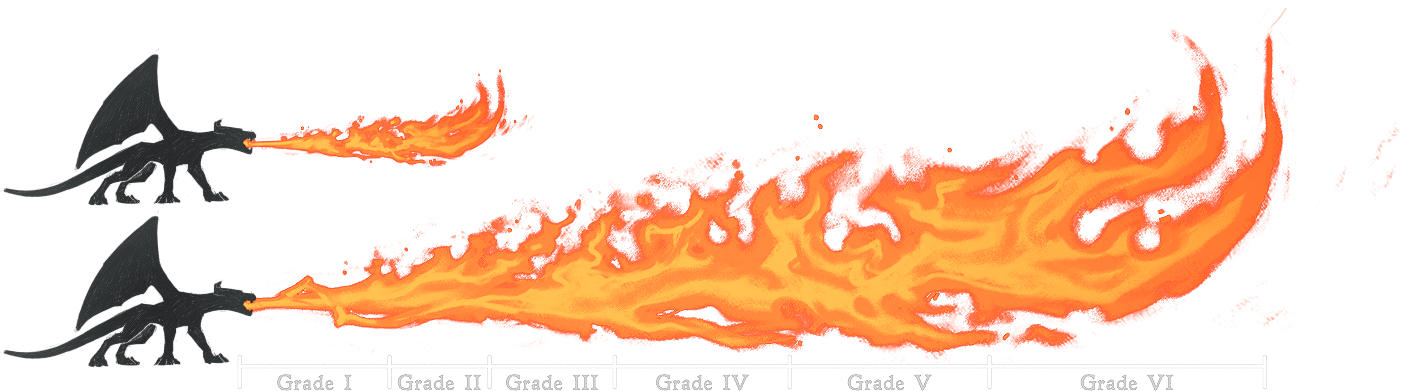
Grade crudely means ‘Class equivalent’. A Grade 4 skill means ‘Class 4 equivalent’; it is the power level of a Class 4, but not exclusive to Class 4. A Class 2 and a Class 6 can have a Grade 4 skill. For the former, this would be due to specialization—for the latter, it is either an undertrained skill or one they are still learning.
A Class 6 dragon attempting a Grade 6 skill for the first time will not perform it at Grade 6 execution. Depending on their current abilities, they may start at Grade 3 to 5 once they successfully execute the skill. Once they master the skill, it will be Grade 6.
Calling (Non-Exhaling Summoning)
The dragon summons their Element in its primary or secondary form without exhaling it.
Both forms of Element can be summoned outside of exhaling, called, such as (with rising difficulty/mastery requirement) on top of or around body parts, around the body, around a small area, summoned from an area, enveloping the body or surface of the body, around a large area.
Like the primary form, the secondary form of an Element can be summoned and utilized in various ways in addition to primary abilities (such as solid ice over one’s claws instead of chilled claws), depending on the form/Element itself and the dragon’s Mastery.
Projectile
Whereas exhaled primary form Element is a continuous stream, projectile attacks are charged, bursts of Element, capable of reaching about three times as far as standard exhalation. Can be both Standard or Secondary form Element. Can be exhaled or called.

Surface Calling
A Calling-based skill. The dragon summons their Element on their own body, such as around claws and/or horns, in either primary or secondary form. Can be for augmenting physical attacks, or protection.
Barrier
Creating a barrier—wall or enclosed area/circle—with one’s Element. These walls are non-solid Element, like a wall of Fire, Electric barrier, etc. Unlike a blockade of solid Element (Ice or Earth), these barriers cause pain and are hard to cross.
Barriers are static, unmovable. They take a chunk of mana when created, and persist without further input for a time. More mana makes them last longer.
Another dragon can force their way through, taking more damage the lesser their own mastery. Using an elemental shield when crossing another’s barrier can lessen the damage.
Elements and Magic can cross barriers largely unimpeded.
Barriers are typically called, as this is instantaneous, but a more crude execution is drawing the barrier line by exhaling it.
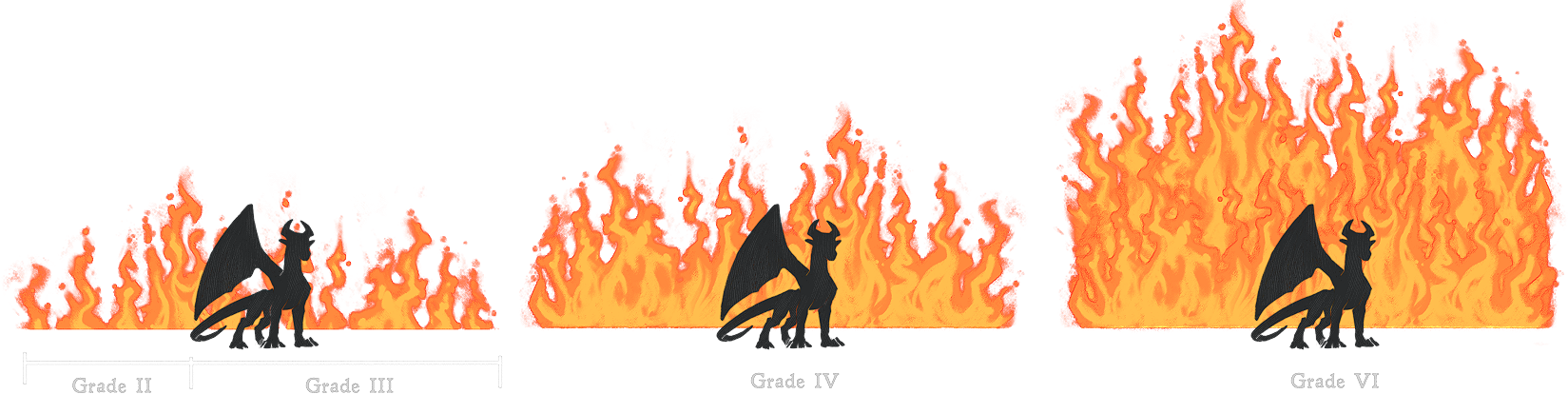
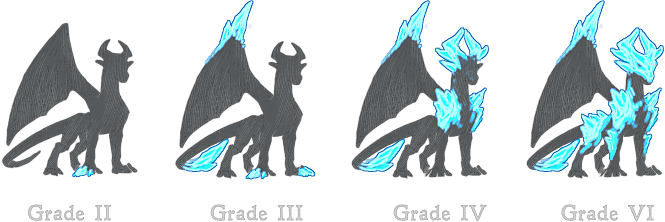
Grade VI has a wider max area-length than shown.
Shield, Bubble, Armor
The dragon envelops themselves in the standard form of their Element. This will protect them from physical and magical (elemental and non-elemental) attacks for a time, during which they can still attack (if they’re very good).
A Class Two dragon can create the beginnings of a shield/bubble, this would be one or two streaks of Element. The surface area of the ‘bubble’ would only be 20% Element, leaving ample opening for an opponent to attack through.
This rises gradually to 60% coverage at Grade Four level, and 100% at Grade Six level.
The Element spins around the dragon when using this skill, so when the bubble is incomplete, hitting them is still a matter of aim and timing.
Shields rely on the Element spinning or circling fast around the dragon to actually deflect attacks, especially physical or solid ones. This can be done in a bubble around the dragon for all-around total or partial coverage, or concentrated on one side as a spinning disc, more like a traditional shield. This is more difficult, having the same Grade requirements but using less mana.
The shield/bubble has to be actively maintained, meaning it will continue to drain mana. Shields are typically used briefly, but ‘winding up’ is the most costly mana-wise, so turning it off and on between the opponent’s attacks is not ideal long-term.
Attacking while using an elemental shield (term including bubble) usually creates holes in it, barring formidably high mastery. When the shield is hit with any attack, it will be damaged or destroyed in proportion to the power of the attack. For example, a dragonkiller bolt moves so fast it tears through most shields, barring the strongest shields, in which cases the bolt is at best slightly redirected. Dragons much more powerful than the dragon using a shield, especially incomplete shields, can destroy said shield in single attacks, but the shield can absorb much of the attack’s damage.
Physical contact with an elemental shield will cause an opponent to be harmed; as such, a shield can be used up as an attack by ramming into an opponent.
At especially high masteries (Class Seven and above), some dragons can rapidly expel and cycle Element around their body, creating a surface-tight armor-like shield that repels attacks and imparts damage. This isn’t especially beneficial beyond the highest masteries, where the dragon can maintain this kind of armor while also spitting attacks.
Note: This armor ability is different to layering oneself in standard or solid Element (Surface calling), which offers less protection, and is possible at much lower masteries.
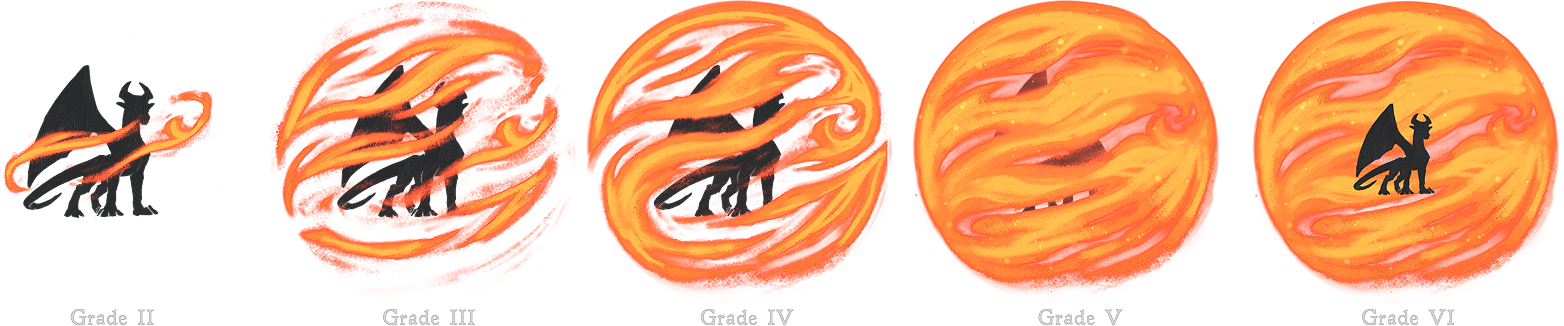
Sprites
The dragon summons balls of primary or secondary form Element around them, which hovers around and ‘follows’ them. With a trigger, they can be launched immediately, saving on wind-up time. The Mana cost of materializing sprites is the same as the regular attack, but holding on to them until it’s time to use them is a continuous, albeit quite slow drain on Mana.
Sprites can offer some protection, as an attacker will have to avoid them to not be hurt by them.
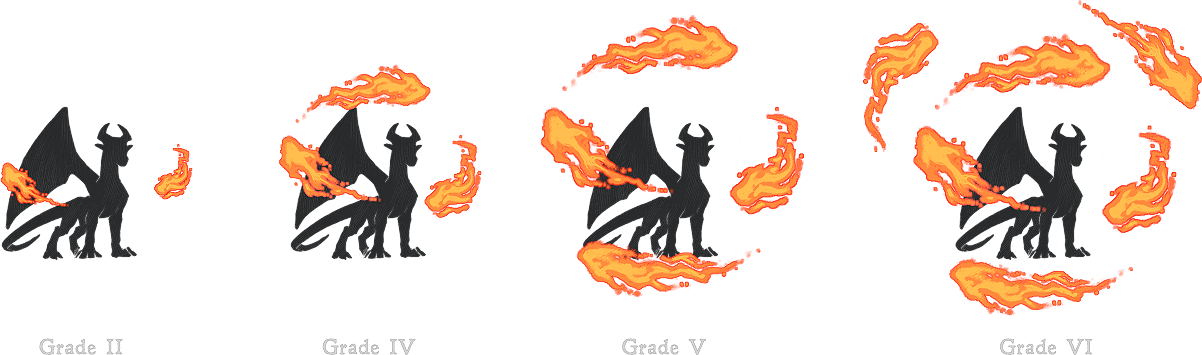
Vortex
In more spinning techniques, a dragon can summon their Element in tornado-like fashion, in either an area or around themselves (typically with themselves spinning along inside it, as this makes the technique easier), which can suck up smaller targets and throw them up and around, or just knock down or impart damage to larger or more magically powerful targets.
This ability can be done starting at Class Three level, with the vortex being body-size relative to the dragon. It then scales exponentially with class equivalent, and can spin faster, throw larger targets, and throw projectiles from itself (like Ice shards or Fire bombs)
Boosting
Dragons can summon their Element as a temporary physical boost; the effects of the boost being Element dependent, such as Fire boosting physical strength, and Electricity boosting physical speed.
Intensity and duration of these effects are mastery/grade dependent.
Influence
Dragons can to varying degrees influence the non-magical form of their Element. Fire dragons can grow or extinguish real flames, Ice dragons can raise fresh snow or pull dangling icicles to come crashing down upon their opponent under them—Water dragons affect their natural element most easily when they swim, allowing them to swim faster.
Fury
The final, most devastating ability; the dragon unleashes the full power of their Element in a wide area around them, both primary and secondary form, culminating in a destructive blast outwards.
A Fury represents the dragon’s destructive potential in one single attack, which grows more and more devastating as a dragon rises in power and mastery. Furies will damage or destroy everything in its path, even allies. It is difficult to temper one’s Fury and limit its destructiveness—very few can do this.
This ability is not an attack that can readily be summoned; it is slowly built up through continuous combat and Element usage, and diminishes when the dragon is no longer fighting.
This ability is so intense and demanding that, if attempted in lower masteries, it can present a risk to the user’s life. Most tutors will not attempt to instruct a dragon in this ability until they are at least Class IV (four), but without letting the dragon actually attempt it—this is so they have the means to attempt it in a situation where they would otherwise most likely be killed anyway.
Only after Class V (five) can the ability be safely trained, though performing one often leads to loss of consciousness, or extreme physical weakness. Thus, in real combat, this ability is still reserved for emergencies, but training it allows a dragon to perform it reliably, whereas untrained dragons will often not be able to perform it even when it counts.
After Class VI (six), a Fury can be performed without crippling effects to the user, but it will always cause weakness, no matter the mastery beyond this.
Without training and instruction, it’s very rare for a dragon, especially in the lower masteries, to perform a Fury successfully.
Other
There are many other skills, ways one can choose to wield one’s Element. For example, dragons who are not combat-oriented, but rather performers, can mold their Elements into barely-damaging but spectacular displays, like fireworks-esque techniques or even summoning their Element in recognizable, consistent shapes to tell a story. An Earth dragon can gently impart their Earth energy into a plant, tree, or crop to strengthen it. These too, are skills/techniques.
Examples
Below are some hypothetical dragons, their mastery Class, and what they can do with their Element, and how relatively well.
- Class III (three) dragon:
- Primary form exhalation
- Secondary form exhalation (Grade II)
- Ranged (primary form only – Grade IV)
- Sprites (primary form only – Grade II)
- Class V (five) Ice dragon
- Primary form exhalation (Ice mist) – Grade V
- Secondary form exhalation (Ice shards) – Grade V
- Combined primary and secondary form exhalation (Ice mist with Ice shards) – Grade V
- Ranged (both forms) – Grade V
- Barrier (straight barrier only – cannot do circular barrier) Grade IV
- Surface (specifically claws and tail simultaneously covered in solid Ice) – Grade III
- Class II (two) Fire dragon:
- Primary form exhalation
- Surface (can envelop tail spade in Fire, augmenting tail strikes – cannot envelop other parts of their body, only tail – Grade II)
Magical Resistance
Magical Resistance
Dragons of higher power don’t only grow powerful in the destruction they can leave in their wake, but develop resistance to other Elements and Magic, as well as somewhat of a magical, general durability.
A Class Two dragon may be shot dead by a single strike from a Class Nine, but a Class Seven dragon will endure it and withstand several more.
A Class Four Fire that can leave a nasty burn on a Class Two, may merely darken the scales of a Class Eight.
Effectively, it would take as many attacks for a Class Two to kill another Class Two, as it would take a Class Nine to kill another Class Nine.
This kind of durability extends somewhat to physical, non-magical damage. It is said a dragon’s Element is part not only of the dragon’s Spirit, but their body also, and a stronger Element enhances or protects the body. An arrow that would strike the heart of another dragon may only go half as deep into a formidably powerful dragon.
Common Knowledge
Common Knowledge
The intricacies of the Elements and mastery are not commonly known, even slightly. The average citizen might know the Element they breathe could be made to explode, somehow, but 95% of the time they won’t figure it out themselves.
Without a formal/formal-equivalent education, or being well experienced and traveled, a dragon will be surprised by the extent of power and skills an Element can have. The majority of dragons know the standard and pure Variants of their own Element. It’s common for them to not remember the pure variant of other Elements (or all variants of other Elements), since they are so rare. It’s not uncommon to mistake Green Electricity for a dark Variant (confused for Green Fire), and Deep Blue Ice for Black Ice. Educated or well traveled dragons usually know the difference.
In cities, Variants are better understood (due to the number of dragons around and their diversity), but most dragons don’t see advanced elemental combat nearly enough to discern mastery levels or recognize skills. In the Temples, advanced Element abilities and powers are shown to children by Guardians.
The knowledge needed to advance in mastery, or tutor another dragon to advance their own mastery, is rare. Self-teaching is very unbalanced, and being an effective teacher, knowing the ins and outs of one’s Element, takes decades of study and training by itself. This means ascending mastery without a good teacher is slow, or prohibitively rare, and that a dragon being X mastery doesn’t automatically mean they can tutor another dragon well, even if taught by a proper master themselves.
For most, becoming powerful in Element is a mystery, and the best they can do is train and see where it takes them.
- Variant
- Each Element has multiple Variants; different colors of the Element with different properties
- Standard/Original Variant
- The default, or first, Variant/color of an Element
- Element Primary Form
- Default shape and function of an Element (e.g. freezing Ice mist)
- Element Secondary Form
- Secondary shape and function of an Element (e.g. cutting, solid Ice)
- Virtues
- The attributes of an Element; its max range, speed, area, Mana drain, etc.
- Different Elements have different base Virtues (Electricity having a longer default range than Earth)
- Virtue Bias
- What Virtues a dragon unintentionally favors when using and training their Element, and which Virtues fall behind
- For example, an overtrained range and undertrained speed and area.
- Prevalent with informal, brief, or self-training.
- Typically leads to an overly unbalanced Element that prevents further overall advancement
- What Virtues a dragon unintentionally favors when using and training their Element, and which Virtues fall behind
- Virtue Metier
- Virtue Bias but intentional—allows a dragon to train their Virtue to a higher grade and selectively sacrifice other Virtues.
- Requires formal/higher quality training
- Allows for Virtues of higher Grade than one’s actual mastery, even if unable to ascend to higher mastery overall
- Allows continued advancement if applicable, but at slower rates
- Virtue Bias but intentional—allows a dragon to train their Virtue to a higher grade and selectively sacrifice other Virtues.
- Specializing
- Instead of or in addition to Virtue Metier, a dragon can specialize in techniques directly, allowing them to perform specific tasks or skills that requires more advanced Virtues than they have, but only for that technique.
- Prevalent in non-combat trade and traditional family techniques.
- Only really relevant for lower masteries (Class II to IV)
- Instead of or in addition to Virtue Metier, a dragon can specialize in techniques directly, allowing them to perform specific tasks or skills that requires more advanced Virtues than they have, but only for that technique.
- Summoning an Element
- Using an Element in any way
- Calling an Element
- Summoning one’s Element in any way other than exhaling it
- Class
- The overall mastery level of a dragon
- Grade
- The level of individual virtues or skills, grade meaning ‘class equivalent’
- A Grade III skill means a skill that a Class III dragon can learn without overtraining
- Skill/Techniques
- How an Element is utilized; Ranged attacks, Shield defense, Trade utility/non-combat, etc.
- Average masteries can learn one or two skills in addition to exhalation, while higher masteries can learn a few more.
- Higher mastery dragons won’t know every skill nor manage new skills at high grade (mastery equivalent) on first try.