Dragons are as a rule named after their element in some way—for example; Glacer (Glacier – Ice), Rayne (Rain – Water), Scorchis (Scorch – Fire)—with often a latin-esque suffix, i.e. -us, -ius, -cus, -is, -a, -i, -in, -er, -en.
The elemental words aren’t always in common tongue, so a name’s meaning may not always be obvious, i.e. Isrun, Isolda, Isra (‘Is’ being a word for ‘ice‘) or Lynerius, Lynis, Lynaricus (‘Lyn’ being a word for ‘lightning) or Tordner, Tordena (‘Tord(en/ner’) being a word for ‘thunder/thundering’).
Dragon given names are always a single word, never hyphenated or with special characters, and rarely an entirely unaltered word (such as Flame, or Ember). Titles such as ‘(Name) the First/Second/Fifth/etc.’ are also rare, limited only to existing monarchies or in descendants of past monarchies. As a rule, inherited names are altered slightly, i.e. Vitreis to Vitreus. If a dragon is given the same name with the same spelling as a relative, that relative is typically a direct ancestor and already deceased.
Names with the suffix -us are considered masculine, while names with the suffix -is are considered feminine. Names ending with -e(r), or -a are more gender neutral, but leaning masculine and feminine respectively. Still, dragon names are not strictly gendered, males can be given feminine suffixes, for example.
Dragons have no surnames. For identification, dragons will introduce themselves as ‘[Name], (son/daughter/child) of [parent name]‘, e.g., Lynerius, son of Tordner. Clan dragons may use their clan name, but not as [Name] [Clan name}, but as [Name] of [Clan name], i,e. Auralis of Tempest Reign.
Typically when introducing themselves with the names of their parent, dragons name their same-sex parent, i.e., sons naming their fathers, daughters naming their mothers, but this is not always the case. If the same-sex parent is absent, unknown, or disowned, a dragon may introduce themselves with the name of their opposite-sex parent. Non-binary dragons can choose which parent to name, though it will often be the parent they’ve introduced in the past. The main rule is consistency.
If a dragon does not know their lineage, they will introduce themselves with the place they were hatched, i.e. Stryga, daughter of Warfang City. This is also the case of adopted dragons, as it is taboo to name one’s adoptive parents when introducing themselves, due to them not sharing blood. This is especially taboo if the adoptive parents are Clan dragons, and the adopted is not.
Generally, adult dragons will not introduce themselves with their parent’s name, as they will want to be recognized by their own accomplishments (not their parents’) and often have titles of their own, such as rank or profession (Soldier, Cropkeeper, Scribe, Caretaker, etc.) but their heritage will be included in official registry.
Changing one’s name is not a social or legal option, it is viewed to be strange, or even looked down upon due to the association with dark dragons who underwent corruption, casting away their birthname to take on a new name based on their dark element. Due to dragon names not being strictly gendered, even transgender dragons will usually keep their birth name, at most only changing their gendered suffix, which is acceptable.
Dragons’ written language comes in the form of runes. These runes stand in for sounds, words, phrases and concepts, allowing dragons to read and write optimally. The runes are written top to bottom, right to left.
Rune examples;
The list below shows some words that are not used in dragon society, and the words they are replaced with.
The list below shows words frequently used in dragon society, with synonyms that are also used.
The list below shows original words and their meanings, or real words and their in-universe meanings);
Dragons are usually monogamous. While commonly heterosexual, romantic and sexual relationships between dragons of the same sex/gender are so common nobody would raise a brow to it. Polyamory is unusual, but not unheard of, to varying acceptance.
Dragon partners can marry and become Unified. This is an official acknowledgment of partnership, and a spiritual union. Diverging (divorce) is legal, but viewed unfavorably. Unity is most often signaled by horn or tail rings.
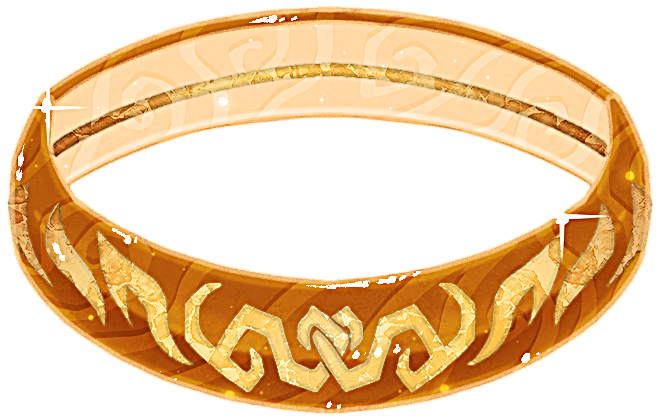
Unity bands are rings worn on a dragon’s horns or around the end of their tail. They signify that a dragon is Unified to another. It is up to preference if the dragon wears the ring on their horns or tail, and which horn is also up to choice. All Unity bands display the Uniting Crest, the symbol of Unity.
A Unity band may be as plain and cheap as can be, but the crest is always there. Otherwise it is not considered a Unity band. The average Unity band is made of one or two common metals, with the Uniting Crest and other (usually elemental) decor etched in.
The most well known aspect of Unity bands is the more expensive inclusion of the Enthral Crystal. This is a costly crystal that, when exposed to dragon elements and magic, absorbs it and reflects it back. This crystal glows and pulses slowly with the magic of the dragon that infused it. The crystal is extremely popular for shrines and other items of sentimental significance. While often used in jewelry, when it comes to rings it is exclusively used for Unity bands.
A Unified dragon wears the ring with their Unified’s magic (Element, usually) within it. The crystal can hold on to the magic for a century when used in rings, and for much longer in larger, intact pieces. The crystal reflects all colors of the element and/or magic within it. The magic of multiple dragons may be put in, and they will not blend. For Unity bands, however, the magic comes only from one individual each, and is either infused with element or less commonly, non-elemental magic.
The more Enthral Crystal is inside the ring, the more expensive it is. In Clans and high society it is common, expected, for the full length ring to display crystal, and to be of rare metals. It is highly unusual for the Unity bands of low-class, menial workers to include Enthral Crystal or be made of rare metals. Unity bands are generally worn all the time, as is expectation. Soldiers and Guards may leave theirs in safer places, however, to prevent loss or theft of the rings.
Most often, the bands are not a solid piece, but two connected pieces that can be removed and put back on, as tails and many horns don’t allow the rings to be pushed down to the desired location. Some dragons choose to have the ring halves soldered together once on the horn/tail. The rings will be shaped to fit the dragon’s horn/tail, not necessarily oval.
In high society, arranged Unity/marriage is common. Clans often wed members into different clans/high families or to individuals of interest to expand their power and influence via connections and alliances. Often, a clan’s only interest is reproduction. In these cases, Unity may not happen, instead, a contract is written that states the two dragons will reproduce once, then go their separate ways. How a clutch is divided is pre-determined in the contract, covering all scenarios. Usually, the more powerful family takes their pick, and the other family takes the rest. They may also have to give gifts of treasure and coin to the bigger clan, as theirs has been empowered by more ‘worthy blood’. If one family takes all the eggs, they will pay the other family handsomely. The parent whose clan is not keeping a given egg will as an unwritten rule not be involved in that child’s life, and it is taboo for either the parent or child to seek each other out.
Clan members can and do unify for genuine love, but if the clan rejects their chosen partner (on account of being the wrong element, clanless, not sufficiently powerful, etc.), then said partner and any children may not be recognized as part of the clan. If the clan forbid the unity and it happens anyway, the clan member may be disowned and lose clan status. A compromise may be made, in which the clan member in question accepts reproduction contracts so as to bear children desired by the clan.
Arranged unity and reproduction contracts are virtually non-existent outside of clans and high society. Among clanless children there’s a stigma against ‘contract egg’ dragons.
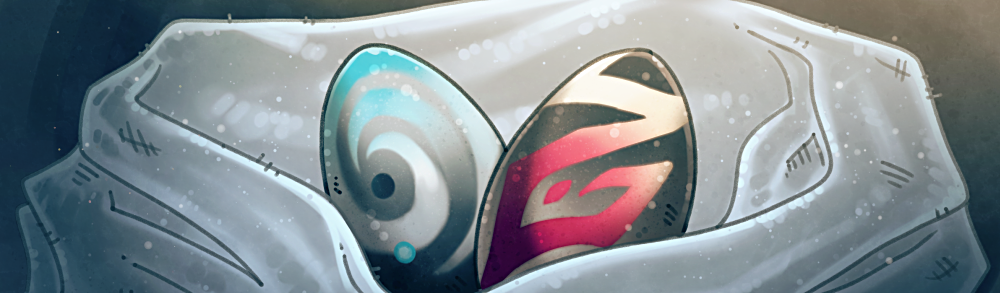
Dragons keep their eggs in grottoes with many other eggs. Historically, communities would have a single grotto for all their eggs, which would be protected by the community’s strongest. After the Unification, this concept was used to create the Guardians, whose duty is to protect the eggs in all of Warfang. Grottoes are kept within Temples, and the eggs are closely monitored and documented. Dragon eggs are very visually distinct, so mix-ups are not a risk.
Clans usually reserve sections of the grottoes for their own eggs. Grottoes are elementally enhanced – Fire eggs are left among burning coals, Ice eggs among freezing ice, Electric eggs among lightning crystals, Earth eggs among living flora, Wind eggs enveloped in small ‘wind pockets’, and Water eggs sitting in rippling water. This elemental enhancement is believed to strengthen the hatchling within, mimicking the environments dragons were initially divided into, but it’s not strictly necessary.
It’s considered irresponsible to choose to keep an egg in one’s own protection, as a few dragons can’t compare to four powerful Guardians and hundreds of strong Templars, nor to the magic that protects the grottoes.
When dragons want to give up their eggs permanently, it’s common to leave them by a Temple. While this abandonment is illegal, the Temples do not pursue an abandoned egg’s parents. Abandoned eggs are sometimes adopted into other families, but most often are raised in the Temple orphanages by caretakers.
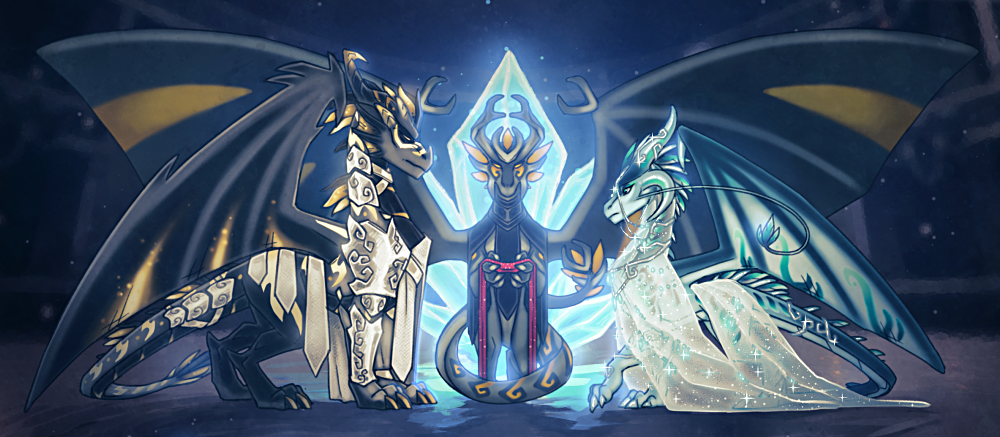
Upon arrival, the families of the betrothed will give offerings to the Ancestors, in the form of tribute that the Votary returns to the Temple. This is effectively payment for their services, and is in present day usually just Coin. In the past this was food, material, craftwork—sometimes, families who specialize in these things may still give these kinds of offerings. A family giving poor offerings is extremely frowned upon, and reflects poorly on the marriage’s longevity and quality, It’s not uncommon for guests to make offerings too, with significantly less pressure to give much.
As these offerings are given, they are placed by the spirit gem, and the dragon giving them may touch the gem and pray to the Ancestors on behalf of the betrothed. Good fertility is almost always asked for. Once the offerings are concluded, the acolytes carry out the gifts to be taken to the Temple, and the Oath may begin.
The Unity Rite, or wedding, is a sacred ceremony that unites two dragons in the eyes of the Ancestors.
For Fire, Earth, and Water dragons, this ceremony takes place before sunset. For Electricity, Ice, and Wind, it takes place after sunset. If the parties being married are mixed (such as one Fire, one Ice), it often coincides with sundown.
The Rite is hosted by the family that gains a new member, as traditionally marriage is the act of one party joining another’s family. Among commoners this may not always be the case anymore, but in middle and high society, this tradition is always kept. The family usually hosts in their own homes, but if needed can rent a larger venue or hold the Rite in a place of nature, but not public spaces frequented by other dragons.
At minimum, both families attend. Parents of the betrothed are a must-attend (if they are still alive and not disowned), and usually siblings and other close family attend also. In clans, Rites are attended by as many as possible, especially clan elders. Aside from family, friends of the family and friends of the betrothed may be invited if the parents of the betrothed and the family elders allow it. In Clans it is common to have semi-open doors, where other clans or individuals of note can make an unannounced appearance, as this is an opportunity to build alliances. Access to the venue is guarded to keep out undesirable visitors.
All Rites are serviced by a Votary, a religious figure representing the Dragon Temples and the Ancestors. The Votary is accompanied by several acolytes helping them with the service. For every Rite, the Votary brings a spirit gem, which is seen as a direct line to the Ancestors. It is believed this allows the Ancestors to observe the Rite.
The Votary summons the betrothed to stand in front of the spirit gem. At this point, the betrothed are seeing each other for the first time that day. The betrothed may touch the spirit gem and say a silent, brief prayer if they so wish. The Votary will then read the rites, to which the betrothed will answer ‘I shall’. There are a number of different rites to choose from, depending on the couple’s priorities. In arranged unities especially, the Rite of Bloodlines is most often chosen, where the highest priority is reproduction.
For the Rite of Bloodlines, the Votary will then tie a long, vibrantly red ribbon around the ends of the United’s tails, tying them together. The knot is loose, representing blood (in the genetic sense, the union and continuation of two bloodlines) and sex. The united are to wear this knot until consummation. It is believed that if the knot falls off before this, the ‘first night’ will not produce offspring.
In same-sex unities, or unities with Rites not focused on reproduction, the red ribbon may still be used, as sex is a significant part of a marriage. But there are other color ribbons to symbolize other aspects; companionship (golden), love (purple), spirituality (white), family (blue (blood relations and non-blood relations).
Immediately after the Oath, the newly united take to the floor and perform a dance with their tails still tied. This dance is generally very calm, deliberate, and brief. Each family has a different, specific dance. At the conclusion of the dance, romantic uniteds often kiss. For contracted marriages, this may not happen, and is not expected to.
Now One, the uniteds sit and are given offerings from their guests. Unlike offerings for the Temples, these offerings are often not simple coin, but useful gifts for the new couple. Clothes, armor, trinkets, jewelry, decor, utensils, alcohol, food, etc. Each family attending is expected to give something, at the very least coin. Attending without giving a gift is another faux pas. Families usually give one large/valuable gift, rather than each member giving something small. The same is common for friends.
After the gifts have been given, it is time for food, drink, and mingling. This can last many hours. Guests may dance, interact with the newly united, or visit the Votary and/or the spirit gem.
At some point, the newly united will take flight to nest (this is where many lose the red ribbon). Guests and family may stay for a while longer, but the united will not return. Some time after the united leave, the Votary and their acolytes also will, and that marks the end of the Rite. Guests will return home.
Usually, Unity Bands are prepared and ready for the day of the Rite, but they will only be worn after consummation, usually starting the morning after.
For the wedding, guests may wear anything formal that isn’t mostly white. The unifieds will wear formal attire that is all white, though small details like jewelry, and leather, may be pale colored instead. Armor and fabric must be all-white, without gradients, markings, or sigils. Unity Rite attire must have no emblems or clan insignias, but can and should depict holy sigils. While formal armor may be worn, it should only be a few pieces (not full armor), without weapons like blades and no head piece.
The Temples run orphanages for abandoned/orphaned eggs and children. Not every child is lucky enough to be left at a temple, and may be raised in the streets, fed pity-scraps, or used by criminals. Guards may seize these children and hand them to a Temple. Particularly cruel guards may chase them from the city, or at worst (but not commonly, nor legal) kill them, as if they are vermin.
Dragons raised in the Temples have little more than a roof over their heads and bland food to eat. They must earn their keep from a young age, and receive no formal education beyond what the caretakers teach. Orphaned eggs and children may be adopted by families coming to visit the Temples, but most grow up there.
The Temples keep abandoned children until age 18 maximum, when they will leave early for the military, provided they continue to work and participate in raising other, younger children. Children who refuse will be left on their own as early as 12 years old, and they will have to find employment. Many of these children turn to crime for lack of other options, and may find themselves reaching adulthood in a cell—provided they do not lose their lives in the streets, due to other criminals, or Guards.
These orphanages are perpetually over capacity, leading to these conditions. Though the Temples’ coffers provide funding for the orphanages, they also rely heavily on charity, usually from Clans, who are not so eager to give.
After the Unification, the trade of items soon turned into items and labor for currency, and trade of currency for labor and items. Warfang uses a currency consisting of six different coins.
These coins are made with metal alloys. These alloys cannot be created naturally—they are bound through spells, and these spells are unknown to the public to prevent counterfeits.
When these alloys are made to become coins, they are left with a ‘magic signature’, the mark a dragon leaves with their magic. This signature is used to verify the legitimacy of each individual coin if they are suspected to be counterfeit. Warfang maintains a complete list of all dragons who have bound these alloys, as well as samples of their signature for comparison. A magic signature cannot be faked. One needs at least a magic mastery of Class V to be able to reliably read a dragon’s magic signature. Some dragons make their living around verifying the legitimacy of coins used in high-society trade.
As of the fourth millennium, there are 6 different coins in circulation.
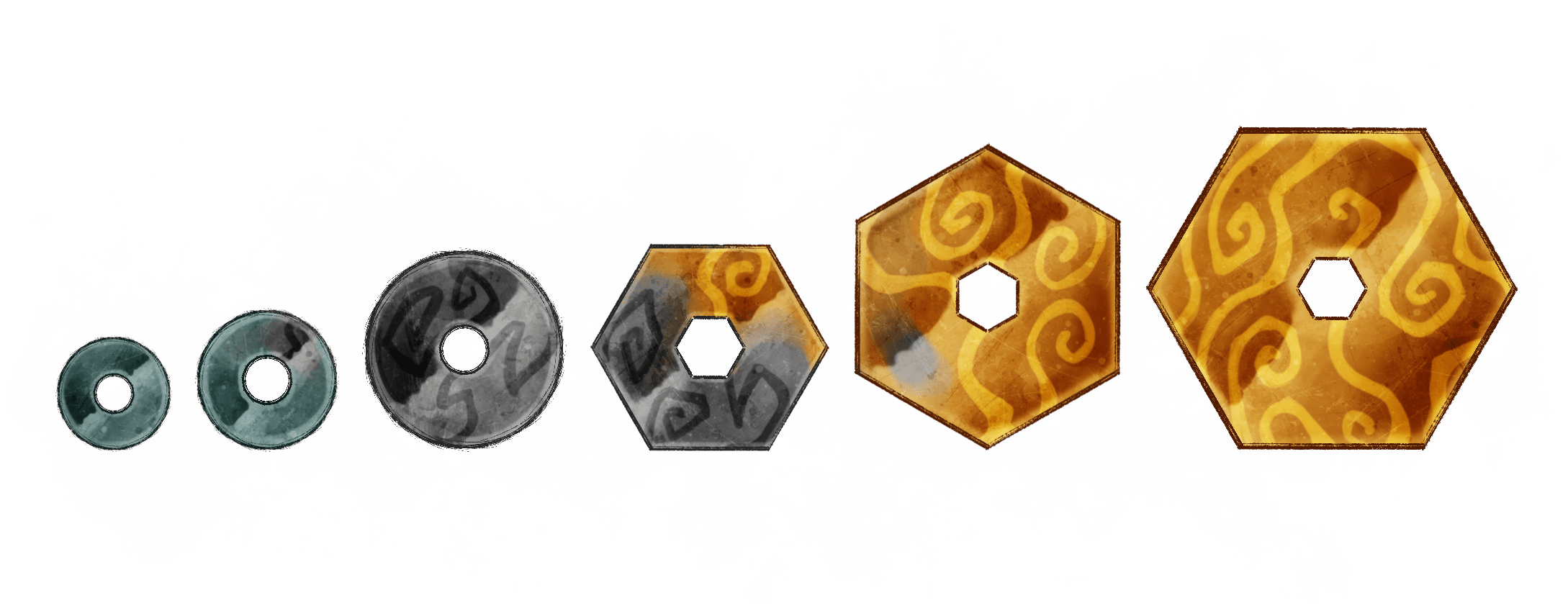
The coin with the smallest worth is in a blue-green metal alloy called Necryte. It is referred to as simply ‘coin’, and has a worth of one. One coin.
The second coin is also of Necryte, but is partially of another alloy called Steel Silver. It is worth 5 coin.
The third coin is a Denar, worth 10 coin. It is made entirely of Steel Silver.
Fourth coin is primarily made of Steel Silver, and partially of Herculeain Gold, a gold alloy that is virtually impossible to destroy. This coin is worth 100 coin.
Fifth coin is almost entirely Herculeain Gold, with a speck of Steel Silver. This one is worth 250 coin, often referred to as a mark. One mark.
Last coin is made entirely of Herculeain Gold. It is the largest coin, worth 1000 coin. It is often simply referred to as ‘Herculeain coin’ or ‘crown‘. One usually only sees Herculeain Gold coins in high society.
The average dragon’s only necessities is food and a place to sleep. As such. Most ‘low class’ occupations yield around one to two dozen coins, provided the dragon works much of the day. Feeding an adult dragon costs almost as much per day, allowing only enough excess to cover other necessities (taxes for their homes) or feeding smaller mouths.
Dragons typically live in family units and pool together coin, if not tending to a family business where the head elder manages all coin. Even Clans basically function with such a system, where the Clan takes most of their members’ income (dividends) and uses this coin for estate upkeep and taxes, food, clothes, armor, tutoring and Temple fees, etc. The coin any given member is left with is for their personal use, as the Clan covers necessities.
Dragons build their structures in circular and curved shapes. Only in cities have rectangular shapes started appearing for the purpose of utilizing as much space as possible, but the vast majority of dragon-made structures are circular or at least curved, with dome rooftops. Even their doors and windows follow this same principle.
Dragons never build houses with wood, only stone and other ideal minerals. Their structures must be element resistant, hence the aversion to wood, but things such as bookshelves and other furniture may be made with wood instead of stone or metal.
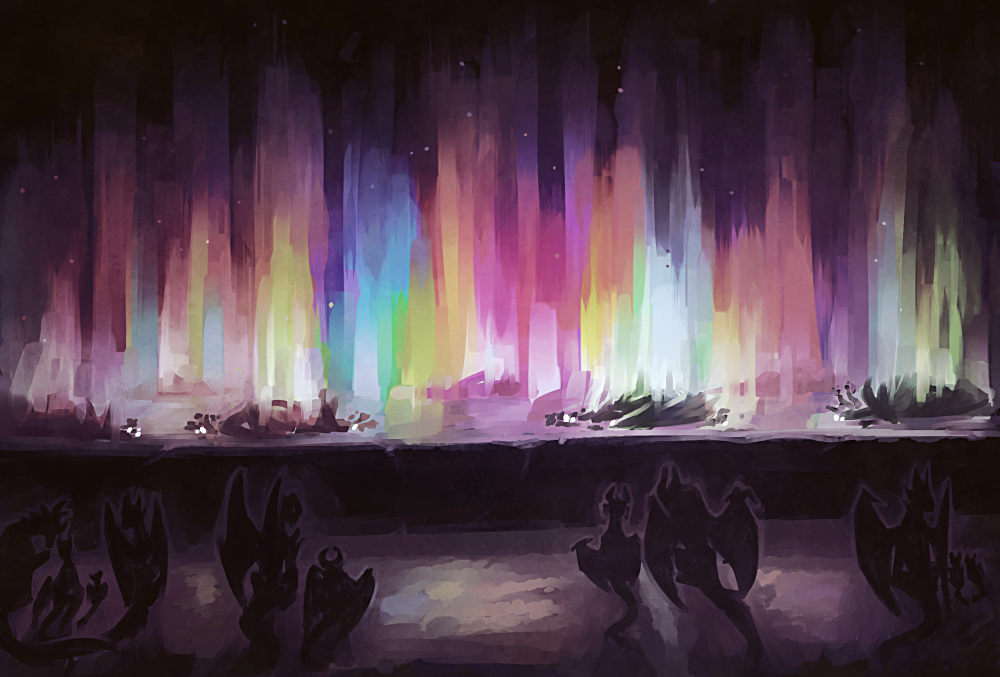
When a dragon dies, a wake is held for them. Family and friends gather to see the deceased ascend to the Ancestors. While individual families deviate somewhat in practice and may have additional traditions, the death of a dragon is most often handled as such;
The deceased is cleaned; if they died from injuries, these are cleaned as much as possible and then covered up, usually with cloth. They are placed on a pedestal, any kind of elevated surface, then the family (usually) decorate around them with flowers and/or crystals. Most notably, a handful of pure Spirit gems are placed around them.
When infused with dragon magic (and not absorbed), pure Spirit gems emit a shifting, colorful light only in the presence of a deceased dragon, and interacts with the body uniquely. The bodies are consumed by the light in a process that cannot be interrupted, and the gem shards themselves vanish also, this process taking mere minutes.
In the Wake, after the Votary (if present) speaks the Rites, the deceased’s eldest descendant, or nearest family member, releases their element or magic as gently as they can, aiming for the few spirit gems laid around the deceased. Then the second eldest joins, until all (if any) children have given their energy. The more dragons who participate, the brighter and taller the ‘aurora’.
Spirit Gems, as all magical gems are, are connected to the Ancestors, and thus this usage in Wakes is believed to be a form of accelerated ascension to the Ancestral Realm.
It is important to note that the Temples and all past Seers hold fast that this method is not necessary for ascension. All dragons who are tended to in death will see their spirits pass on. The usage of Spirit Gems in Wakes acts as a comfort for loved ones (and certainly status for High Society), as the dragon’s remains are ensured to return fully to the Realm, immediately, and cleanly so—sparing the deceased, and most notably their surviving loved ones, decay or searing flesh.
It is a well practiced and widely accepted practice, and the collection of Spirit Gems is lucrative for this purpose. But there is not enough for all, as is more true in recent centuries. While only a few shards are necessary per dragon, purchasing them are outside the means of many.
It is common for low class families to fly out when a member dies, to search the wilds for Spirit Gems. They may be fortunate. If not, they will have to resort to a natural wake. If unfortunate, they lose another family member to the wilds.
Many families, even some High Society ones, prefer natural burials or pyres as part of their personal religious beliefs, and this too is generally accepted; though dragons of High Society often enjoy lavish, performative and wasteful Wakes, especially for Clan Elders; all but burying them in Spirit Gems, non-magical crystals, flowers, and personal, meaningful belongings (even though these remain).
The Army is a revolving door of bodies. Barring mass casualties (wherein wakes will be held in the fields after the battles have ceased), bodies are transported back to the Fort of the soldier’s Division.
Organizing a wake is costly. When soldiers die in battle, the Army will arrange communal wakes, where they have rows of long pedestals that will hold dozens of soldiers as opposed to one at a time. Families and loved ones will attend, and a Votary will say the appropriate Rites, and the mass wake begins, attending families giving their energy at the same time to create a spectacular, tragic aurora of loss.
Guard deaths are less common, but the Guard has a similar arrangement (for those who die doing their duty) that usually sees only a few or even one deceased ascended at a time, and these are given individual pedestals with more distance away from any other grieving families.
The Templar Order arranges Wakes using Spirit Gems for any active duty or recently active Templar, whether or not they passed on duty.
Families may keep noteworthy belongings of their departed, such as a soldier’s helmet, a unity ring, etc. These will be placed on the dragon’s shrine.
After the wake is complete, a shrine is created for the dragon if possible. Shrines have, at minimum, a plate of stone or metal (or other material, usually families stick to the same material) with the name of the deceased engraved. These can be small enough to fit in one’s paw, but dragons that can afford it will go further. Clans typically have an entire building dedicated to their shrines (which may come with life-sized statues), with the individual shrines listing the deceased’s accomplishments and immediate relations, as well as their most valued or noteworthy possessions. These shrines are kept pristine and are visited frequently.
If, for whatever reason, a shrine can no longer be kept, it must be destroyed. Metals must be melted, stone must be pulverized – this is due to the belief that shrines must be respected, and the neglect of a shrine is far worse than not having a shrine at all.
While shrines are a way to honor a dragon, they aren’t tied to a dragon’s believed ascension to the Ancestors. It is often enough to have a wake.
It can be distressing to a family to not have a body to perform a wake for, so in the event a body is unrecoverable, a wake will still be held, using a belonging of the deceased, such as a cape they’d wore, or a recovered piece of armor.
It is believed that a dragon whose body is not recovered, has an unknown cause of death (especially one that was brutal), and had no wake held for them, will become a restless, violent ghost, bound to the Realm and unable to ascend.
Celebrated on the very end of the year, the New Year Jubilation celebrates the end of the current year and the beginning of the next, as well as the anniversary of the Unification, and the Summer Solstice (northern hemisphere) which coincides the same day.
The New Year Jubilation is a holiday. It is celebrated on a national scale, meaning many occupations as well as Temple schools will take the day off. Cities and towns will be decorated to celebrate the Unification and appreciate the unity between the natural elements. There are parades, games, and competitions in the day and private festivities in the evening.
For the northern hemisphere, the Winter Solstice falls in the middle of the Fifth Moon. The southern hemisphere has their Summer Solstice on the same day, but due to Warfang mainland being in the northern hemisphere, the Winter Solstice is the usual name of this special day.
This day marks the beginning of winter, and every Winter Solstice, the Temple schools host an event for its students. For the students between Year One and Year Ten, these are social gatherings with food, entertainment, and games. For Year Eleven up to Year Eighteen, the highlight of the evening is the Solstice Dance. Leading up to the Solstice, students may approach other students to ask them to be their date for the event, and they will dance together at the height of the evening. While one may dance with a friend or a relative, many students wait eagerly for this day to explore their romantic interests. Attendance is obligatory, but dance participation is not.
The Winter Solstice is also an excuse for high society to mingle. Gatherings will be hosted worldwide, with drinks and entertainment for its guests. Masquerades are popular for the Winter Solstice.
1st Day of the Eighth Moon. Remembrance Day is a holiday dedicated to the Ancestors and the recently departed. In the early morning, shrines of loved ones will be visited. They will have been cleaned the night prior. Incense and candles will be lit, and words and prayers may be spoken to the shrines. Each family member will offer something to the family shrine. Children may leave trinkets they’d made at school the days prior, or some flowers they picked. Adult dragons will generally buy or commission some kind of decoration or utility for the shrine, or make it if they can do it well. Among the clans and rich, these will often be of expensive materials, and even the clan youth and children will be pressured to offer something of value. Clans may, before Remembrance Day, arrange expeditions for clan youth to attain something rare or uncommon, to put effort into their offerings as they lack the coin to buy something expensive.
While offerings can be given to the shrine, or specific shrines, every day of the year, Remembrance Day offerings are given to the family shrine as a whole, not any individual’s shrine. The offerings will be distributed by the family elders. Some families will distribute evenly, others will be biased. It’s not uncommon for clan leader shrines in particular to be overflowing with offerings on Remembrance Day.
If food is offered, it must stay until the next day before it can be eaten by the living. Flowers will be removed just as they start to wilt.
Offerings need not be given every year, but in big, wealthy, and/or clan families, a rich, impressive shrine is extremely important for appearances, and they will do the ritual every year.
Remembrance Day ends with a feast before the evening, as everyone will have fasted up until this point.
Once night falls, Remembrance Eve begins. This is seen as an informal part of Remembrance Day and is frowned upon by those traditional. As a day dedicated to death and the deceased, children and young dragons may celebrate it further by adorning costumes and makeup, turning them into depictions of the macabre and ‘evil’. They’ll take the appearance of skeletons, corpses, the wounded, the sick, dragon-eating creatures, dark dragons, cheetahs, apes, spirits, ghosts, and imaginary monsters. Liberties are often taken to allow for colorful and stylistic designs – glowing paint is popular. Some costumes may not be a depiction of death at all; it has become commonplace particularly for older children and young adults to depict themselves as something abstract and appealing. Costumes don’t depict an occupation, particularly as it would be frowned upon to dress as a Guardian, Templar, Soldier, Guard, etc.
Cities and towns will have festivals and parades where dragons in their costumes can frolic the streets, sending up colorful displays of elemental fireworks. Music will be played, and performers will follow. Thematic food will be sold by vendors.
The parade and festival will have been pre-approved by the city/town, and Guard presence will be heavy. Young dragons like to make a game out of pranking Guards but this can often go poorly.
Besides the parade, there may be private parties, competitions, and games.
In high society, it’s frowned upon to participate in the dress-up, parade, and the festival. It is viewed as a commoner’s event. High society has their own events for Remembrance Eve; usually masquerade parties. Make-up and body paint may be used but only in flattering ways, no macabre depictions. It’s not too unusual for high society children to make themselves unrecognizable in paint and a costume and attend the festival anyway, as the high society events are much more dull.
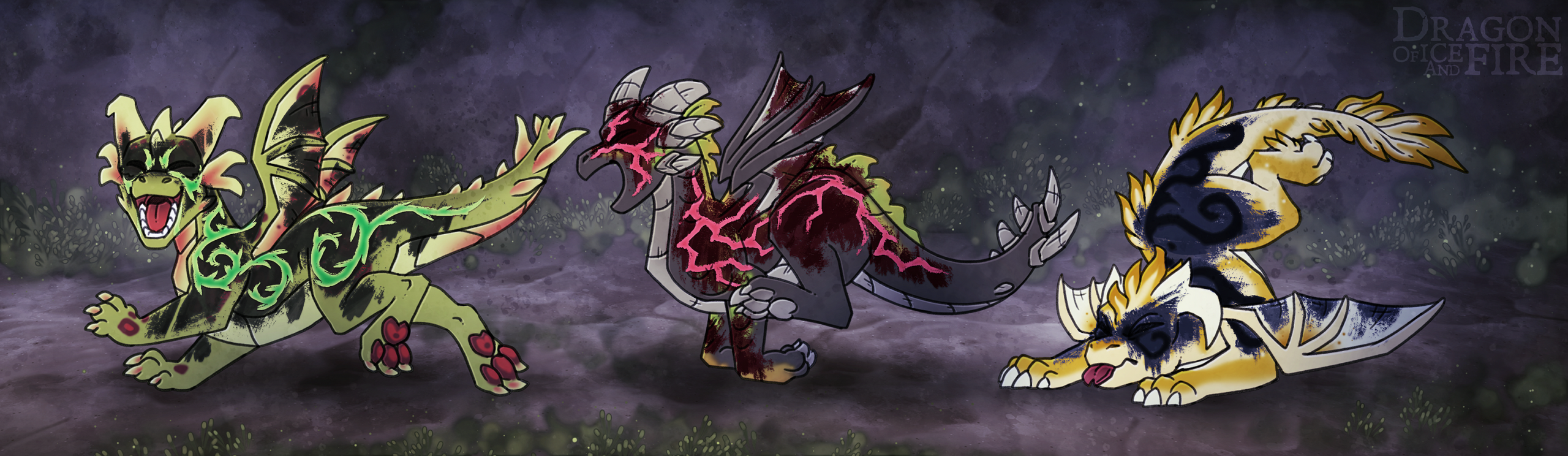
The Week of Aether is also known as The Week of Elements. It is in the first week of the Third Moon. It is a week long, city-hosted festival celebrating each element, marked by element-based performances and competitions with big prizes.
On the first day, Day Draco, the festival starts. There is food and general entertainment, and anyone can sign up for the week’s competitions. The next day, Day Ignis, is the day for Fire. Banners and decoration are changed into the standard colors of fire and depicts fire and fire imagery. Non-fire dragons may paint and decorate themselves so they look like fire dragons. More formal dragons will dress in appropriate colors.
This pattern is reflected for each day of the festival; Electricity for Day Fulgur, Ice for Day Glacies, Earth for Day Solum, Wind for Day Ventus, Water for Day Aqua.
The Week of Aether is a tradition dating back to not long after the Unification, a festival created by the nation of Warfang in an attempt to better relations between dragons of different elements who were now living together. The festival allowed dragons to expose each other to their different elements outside of conflict, encouraging appreciation and understanding. The Week of Aether is culturally significant and important to all economic classes, the Temple Schools will even close for the whole week. Masters and even Elementals may be encouraged to appear and demonstrate their elements. Winning high-end competitions may open many doors to a dragon, such as a marriage invitation into a clan.